Our Garden This Year

Our garden this year started slowly.  We had arranged for a local farmer to till the ground for us in March, but that fell through, and we were at mid-April, the typical last frost time, with a handful of seed packets but without a plowed garden bed.  I’ve read about the no-till garden options, and I wish I would have done that, but I hadn’t, so we were at a standstill.

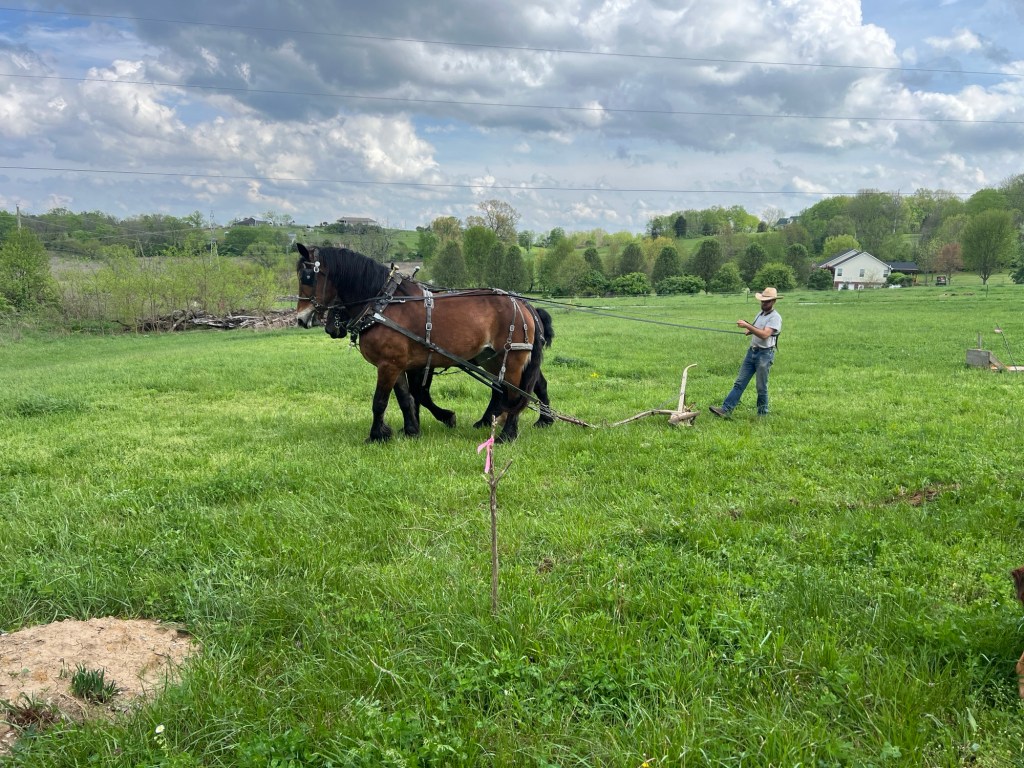
That is, until our new neighbor offered to come over and till the garden with his workhorse and plow!  I felt like a character in a Wendell Berry novel living in Port William. Even our grandkids got to watch!
Then Hule, our daughter, and I, all took turns the next few weeks planting what we wanted from our seed selections.  I wanted squash and okra.  Hule also planted watermelon and pumpkins.  Sarah planted some of the more exotic and heirloom choices. 
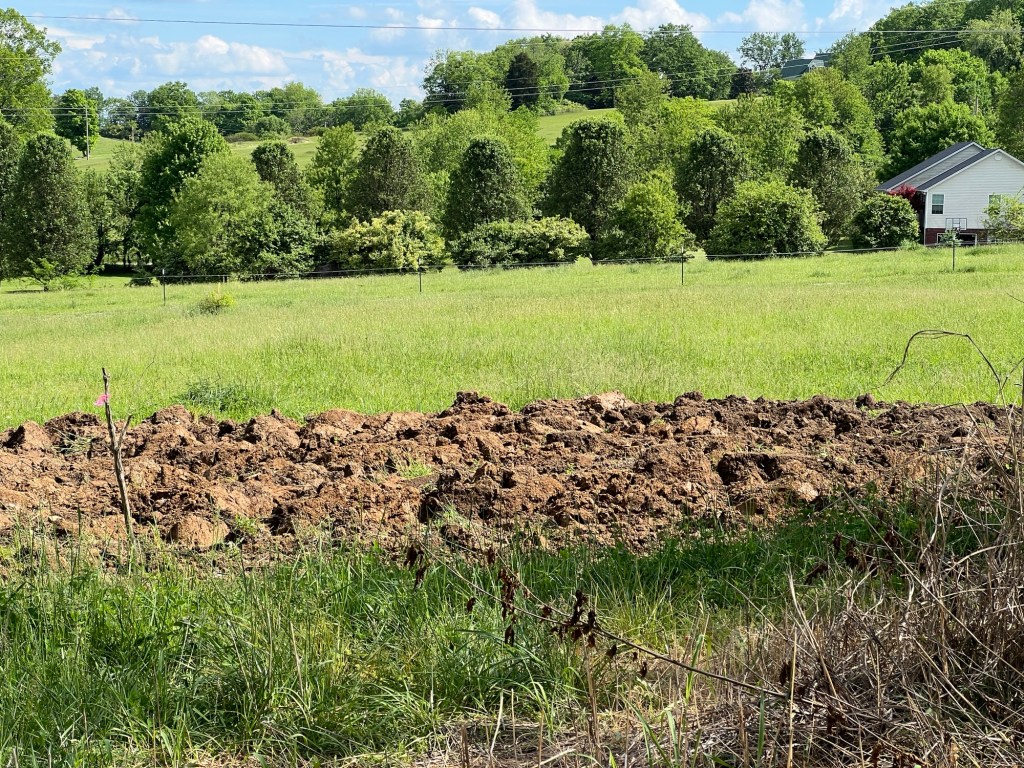
At first there was very little to show for our efforts.  Then there were weeks of drought and hot weather, and we got a sprinkler.  We likely over-watered because our water bill spiked up to over $100 from our typical $44/mo.  There went our “saving money” by having a garden.

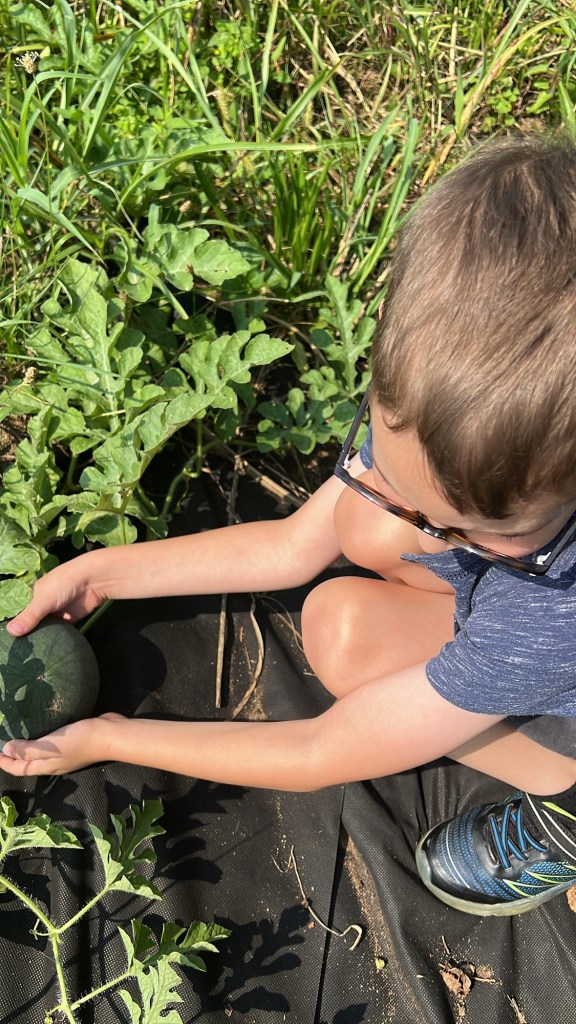
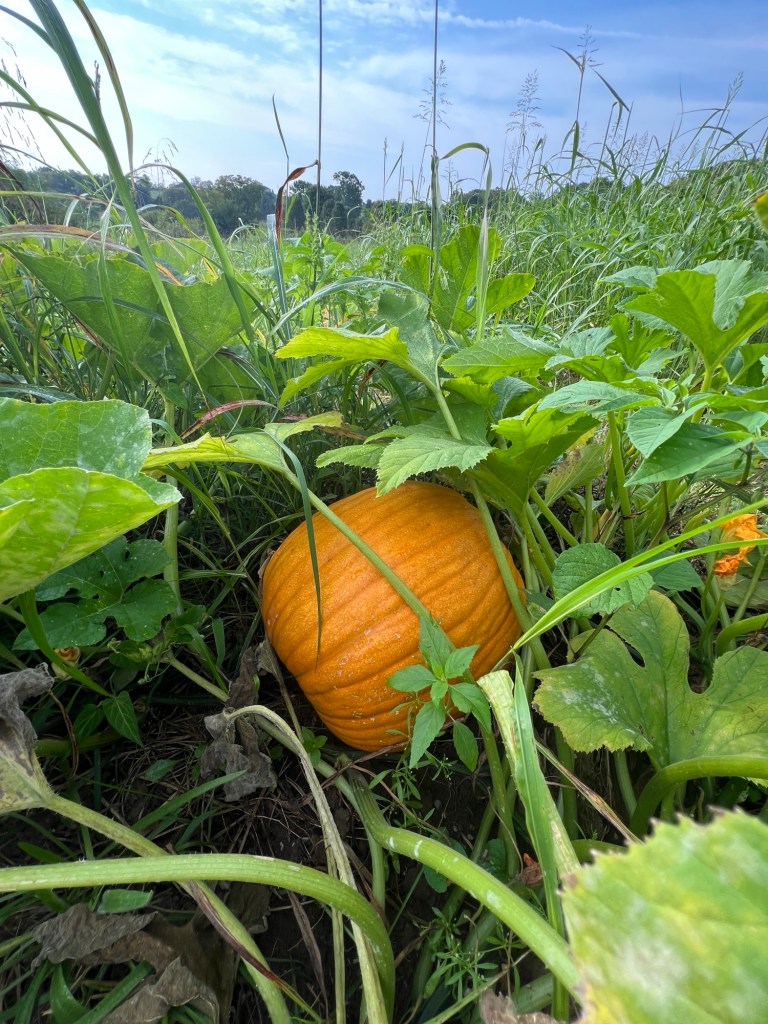
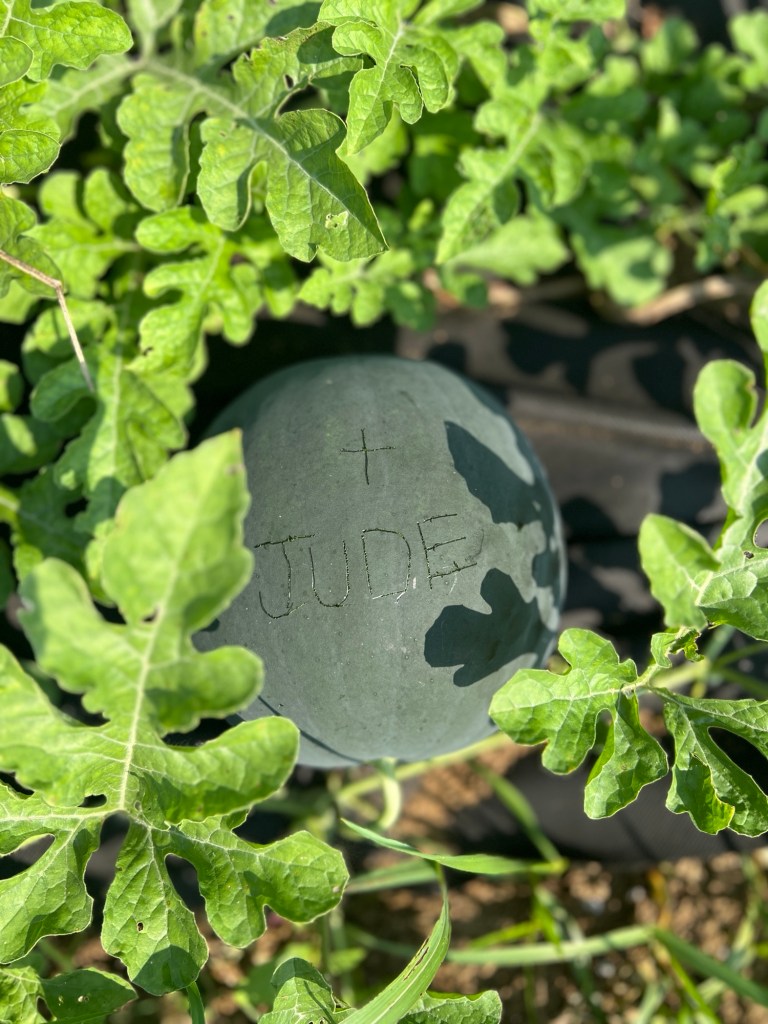
But, eventually, and through many hours of Hule’s tending and weeding and laying out landscape cloth, the okra emerged in a nice straight line.  Little baby watermelons came out—some too cute not to be picked and pocketed by our grandson.  Even pumpkins grew!  That has been fun watching the pumpkin vines stretch out into the pasture as they make more and more small orange globes.
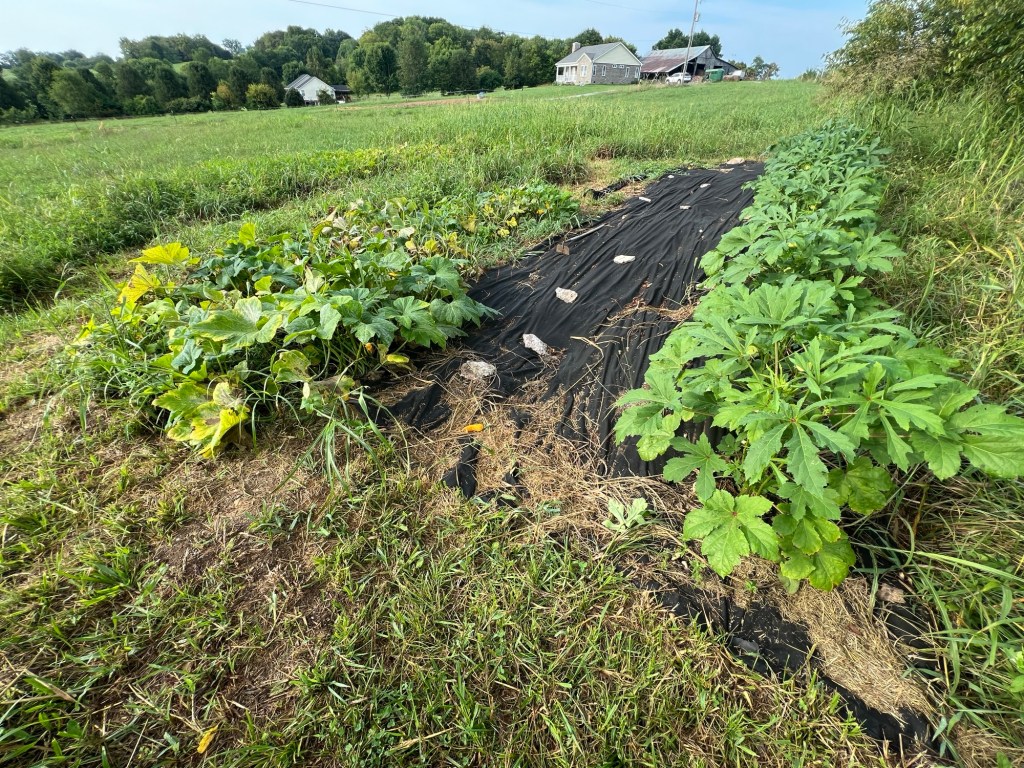
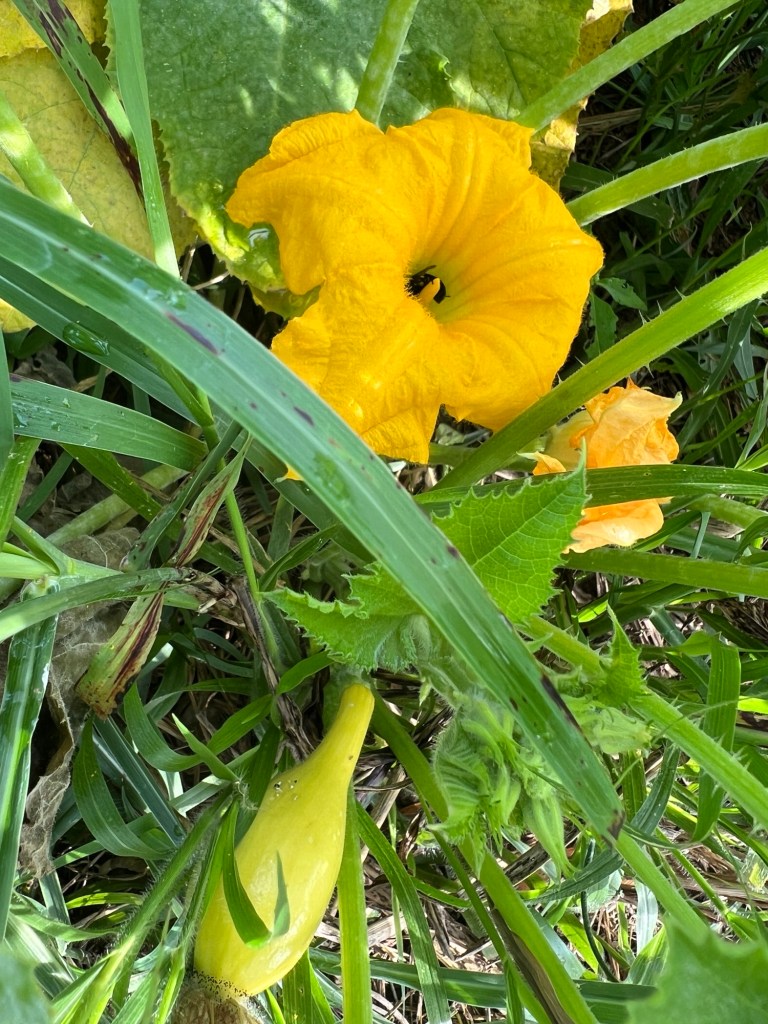
But, by far the star of the show has been our summer squash.  Unbeknownst to us, all 3 of the planters had taken on the task of planting hills of squash.  So—we have been inundated with it.  I’ve made fried squash, boiled squash, stir fry squash, and squash casserole.  We’ve brought bags of squash to our daughter in Lexington and to our neighbor.  And, for those “big’uns” (as my grandparents might have said) we created a new compost pile—a pile of crooked neck gold out in the field that, we hope, will eventually become soil again.  Some of the squash went to our 3 chickens, but they are particular and slow to eat it.  If there is any hope of fruit or worms, they turn their beaks up and snub the squash.

Whenever I watch this miraculous unfolding of vine and leaf and fruit from seed, sun, soil, and water, I am taken aback.  When the small green striped orb in my grandson’s hand becomes as big as his torso in just a few short weeks, and develops into something enough to satisfy several families at a picnic, I am in awe.  When I look at the gorgeous yellow and purple blossoms on the okra stalks morph into green edible pods and the gigantic orange squash blossoms birth cute baby yellow vegetables overnight, I am mesmerized.

The garden becomes a sanctuary.
It all reminds me of a quote—one of my favorite—from Wendell Berry from The Art of the Commonplace: The Agrarian Essays:

“…outdoors we are confronted everywhere with wonders; we see that the miraculous is not extraordinary but the common mode of existence. It is our daily bread. Whoever really has considered the lilies of the field or the birds of the air and pondered the improbability of their existence in this warm world within the cold and empty stellar distances will hardly balk at the turning of water into wine – which was, after all, a very small miracle. We forget the greater and still continuing miracle by which water (with soil and sunlight) is turned into grapes.”

A Good Friday Reflection

As the rain comes down today and I see my packages of seeds awaiting the earth of my garden, being prepared for the death of a seed in the soil, to bring up the resurrection of something new and green–with the un-watering of the sky above; I see the correlation of Jesus’ death on the cross–to bring about a resurrection of hope and redemption offered to us all.

Today our church had a good Friday service in which we contemplate the last 7 words of Christ from the cross. I was asked to participate and I chose Jesus’ words “I thirst” as the focus of my sharing:

I Thirst

By Loretta Goddard, Good Friday 2019

“Jesus, seeing that everything had been completed so that the Scripture record might also be complete, then said, ‘I’m thirsty.’ A jug of sour wine was standing by, someone put a sponge soaked with wine on a javelin and lifted it to his mouth.” John 19:28, 29 (The Msg)

I have been with three people as they died. One, we were trying to keep alive. I gave CPR to him as we awaited an ambulance. The other two were in hospice—one a friend, the other, my father. There were distinct differences in the death we were fighting and the others we were resigned to accept—even welcome.

Jesus’ death was one of acceptance at this point. Those who had eyes to see would even have welcomed it—for it was bringing about their way to redemption! To the Romans and most Jews at the crucifixion, Jesus was the “Dead Man Walking”* —the death row inmate already in the electric chair. To the disciples, the dismayed disciples, it was a horror they were resigned to accept. To Jesus it was the completion of something that began in the garden of Eden when Love, Who wouldn’t let go, began to formulate this plan. Moses wrote about it—the serpent’s head crushed by this woman’s seed* ; as did David, in Psalm 69*, prophesying of this very moment when Jesus would thirst and be offered sour wine.

When I sat with my friend and my father, as they lay dying, I observed that death is:
• an un-breath-ing and
• an un-water-ing.

When we fight death, we start IV lines and push fluids—we know that dehydration is part of dying. When we receive death, ice chips only are offered—or very small sips. Every breath “un-waters.” We offer moistened cotton swabs to cracked lips.

So here on the cross, Living Water was being poured out.

Just a few years prior to this, Jesus sat near a well and told a Samaritan woman: “If you knew the generosity of God and who I am, you would be asking me for a drink, and I would give you fresh, living water.” He said, “Everyone who drinks this water will get thirsty again. Anyone who drinks the water I give will never thirst—not ever. The water I give will be an artesian spring within, gushing fountains of endless life.”*

So now, on the cross, the Giver of Living Water Himself is thirsting. He is dry—parched—poured out—in order to quench our thirst. To bring us the living, gushing waters of saving grace, He is being un-watered with every breath.

Since this “Rock of Ages” gave water for the Israelites in the wilderness* —
Since this God-baby was birthed from amniotic fluid in a stable—
Since coming up from the waters of His baptism* —
Since that day with the woman at the watering well—
Since the dehydrated, un-watered, bleeding woman’s touch of the hem of His garment*-Since the moisture of a kiss of betrayal from Judas to His cheek—
Living, Loving, Water was being poured out.

This Word of God who formed the earth “out of water and through water,”* now allowed Himself, to be un-watered.
Life Himself became “Dead Man Walking.”
The Healer, the Great Physician, was passive. This is the “passion” of the Christ*:                 He became a patient—a hospice patient—submitting to death —
Allowing the un-breath-ing, the un-water-ing, of His death;
to bring us—
to offer us—
fresh living water.

Jesus said, “I thirst” so that we, can be filled with poured out Living Water, and “will never thirst—not ever.”

_________________________________________________________________________________________

*Footnotes:
1. Dead man walking definition: a condemned man walking from his prison cell to a place of execution. https://www.collinsdictionary.com/us/dictionary/english/dead-man-walking
2. Gen 3:15
3. “They gave me poison for food and for my thirst they gave me sour wine to drink.” Ps. 69:2
4. John 4:10 Message, John 4:13/14 Message, italics mine
5. “and all drank the same spiritual drink. For they drank from the spiritual Rock that followed them and the Rock was Christ.” 1 Cor. 10:4
6. Matthew 3:16
7. Matthew 9:20
8. “…the heavens existed long ago, and the earth was formed out of water and through water by the word of God….” 2 Peter 3:5b.
9. “The English word passion takes it root in the Latin, passio, meaning passivity, and that’s its real connotation here. The word “patient” also derives from this. Hence what the Passion narratives describe is Jesus’ passivity, his becoming a “patient”. He gives his death to us through his passivity, just as he had previously given his life to us through his activity.” http://ronrolheiser.com/the-passion-of-jesus/