Our Garden This Year

Our garden this year started slowly.  We had arranged for a local farmer to till the ground for us in March, but that fell through, and we were at mid-April, the typical last frost time, with a handful of seed packets but without a plowed garden bed.  I’ve read about the no-till garden options, and I wish I would have done that, but I hadn’t, so we were at a standstill.

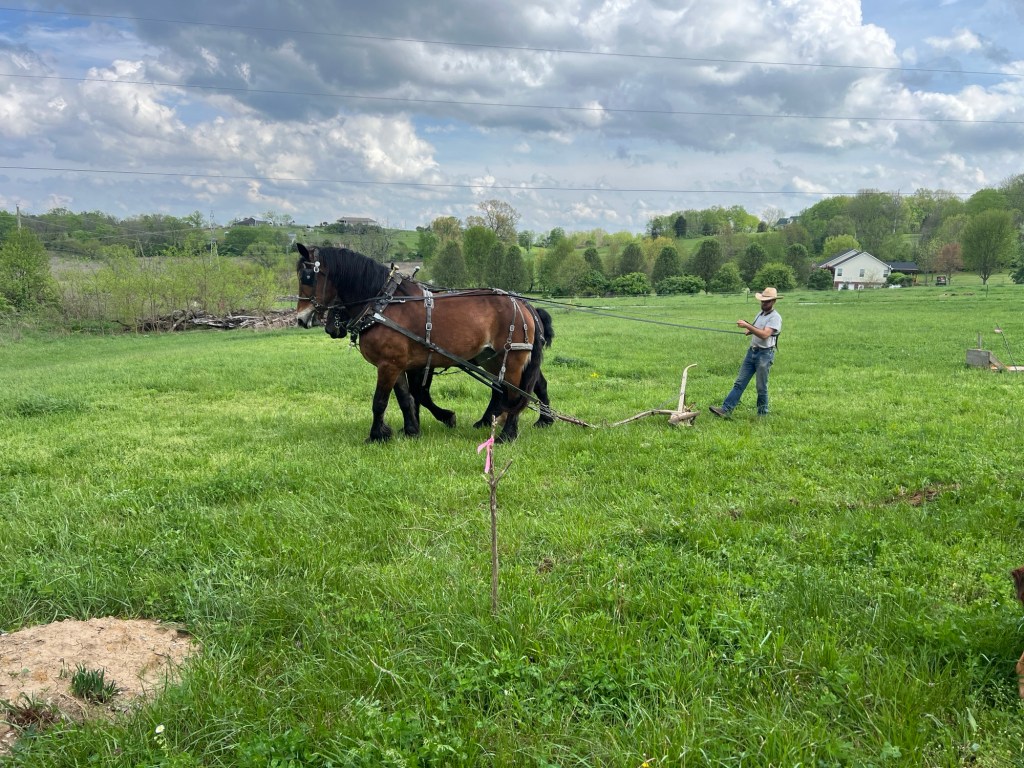
That is, until our new neighbor offered to come over and till the garden with his workhorse and plow!  I felt like a character in a Wendell Berry novel living in Port William. Even our grandkids got to watch!
Then Hule, our daughter, and I, all took turns the next few weeks planting what we wanted from our seed selections.  I wanted squash and okra.  Hule also planted watermelon and pumpkins.  Sarah planted some of the more exotic and heirloom choices. 
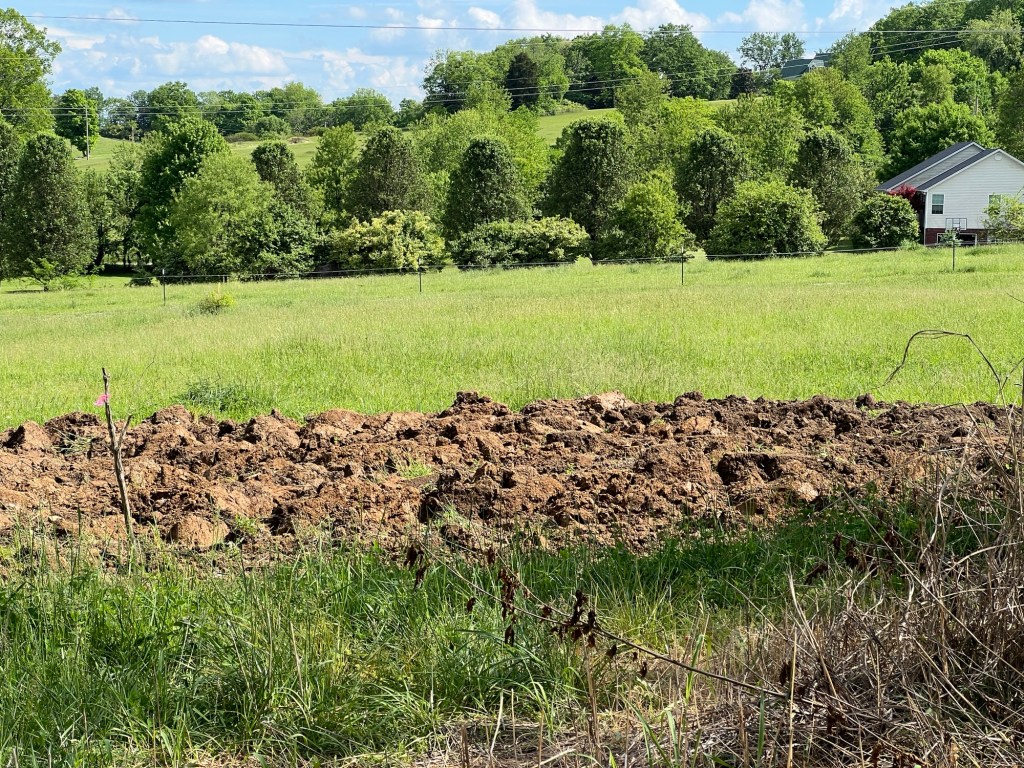
At first there was very little to show for our efforts.  Then there were weeks of drought and hot weather, and we got a sprinkler.  We likely over-watered because our water bill spiked up to over $100 from our typical $44/mo.  There went our “saving money” by having a garden.

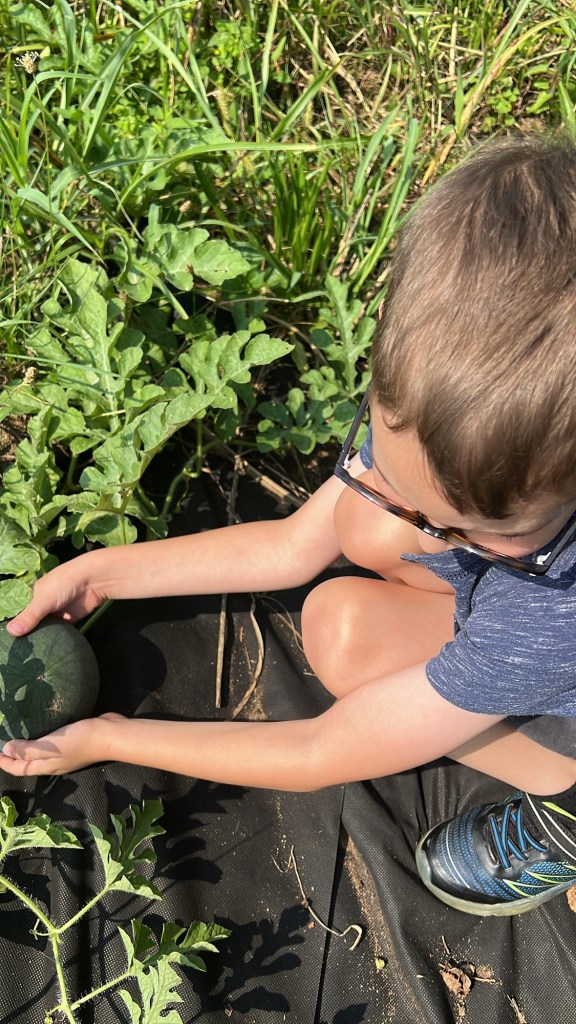
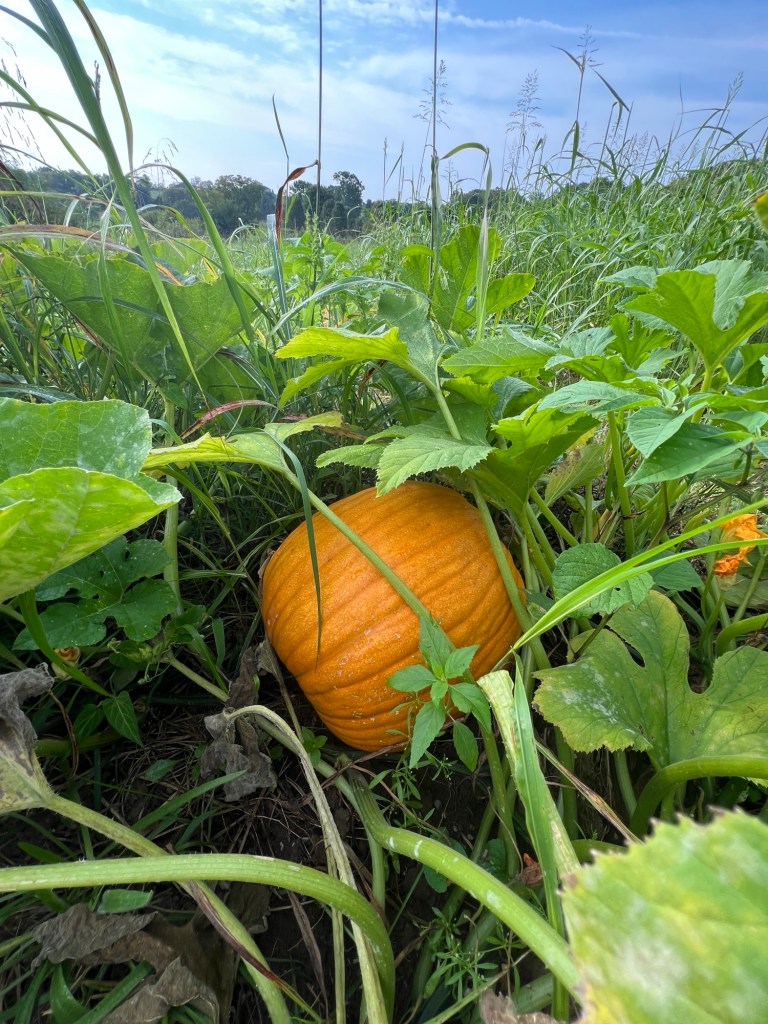
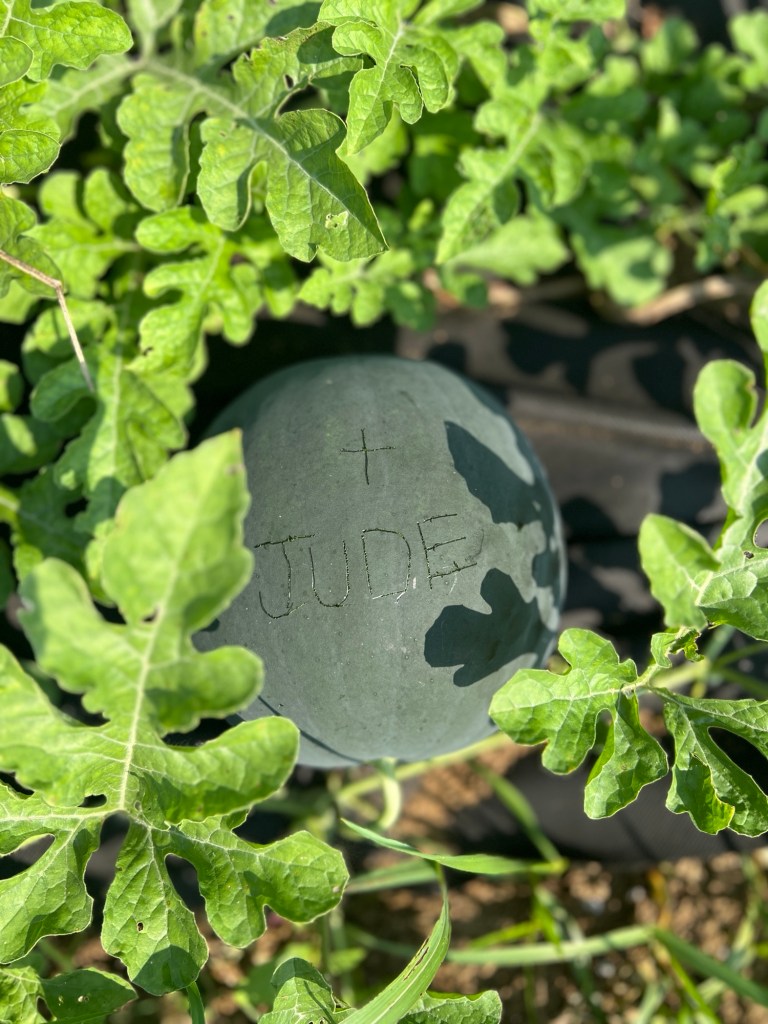
But, eventually, and through many hours of Hule’s tending and weeding and laying out landscape cloth, the okra emerged in a nice straight line.  Little baby watermelons came out—some too cute not to be picked and pocketed by our grandson.  Even pumpkins grew!  That has been fun watching the pumpkin vines stretch out into the pasture as they make more and more small orange globes.
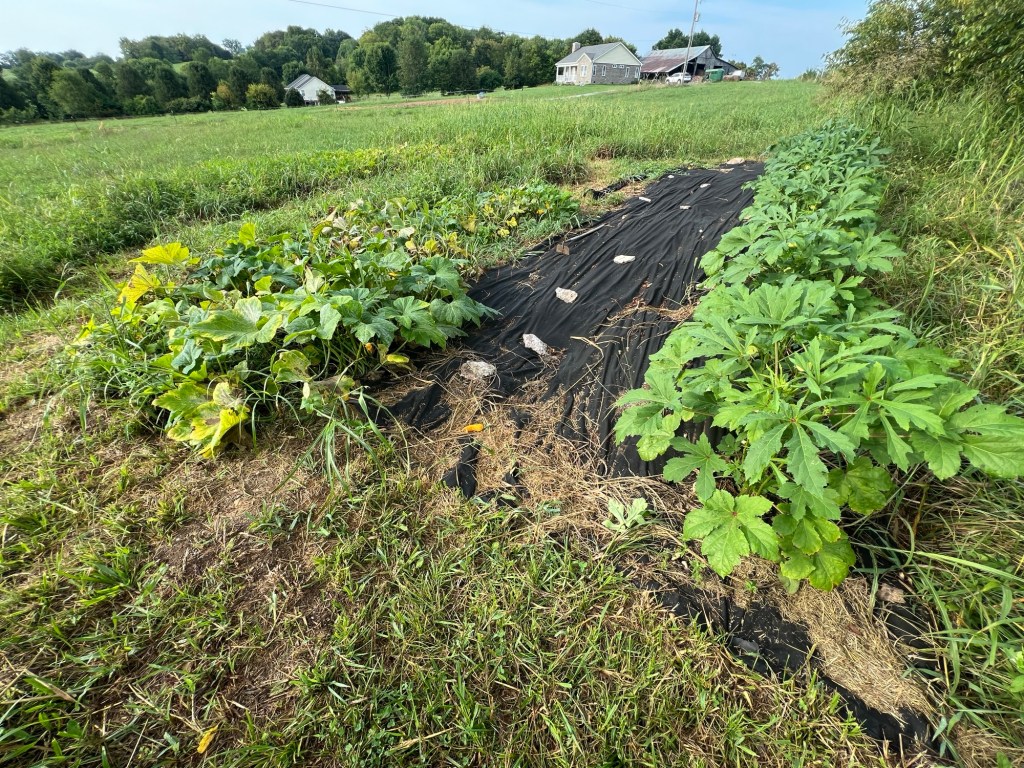
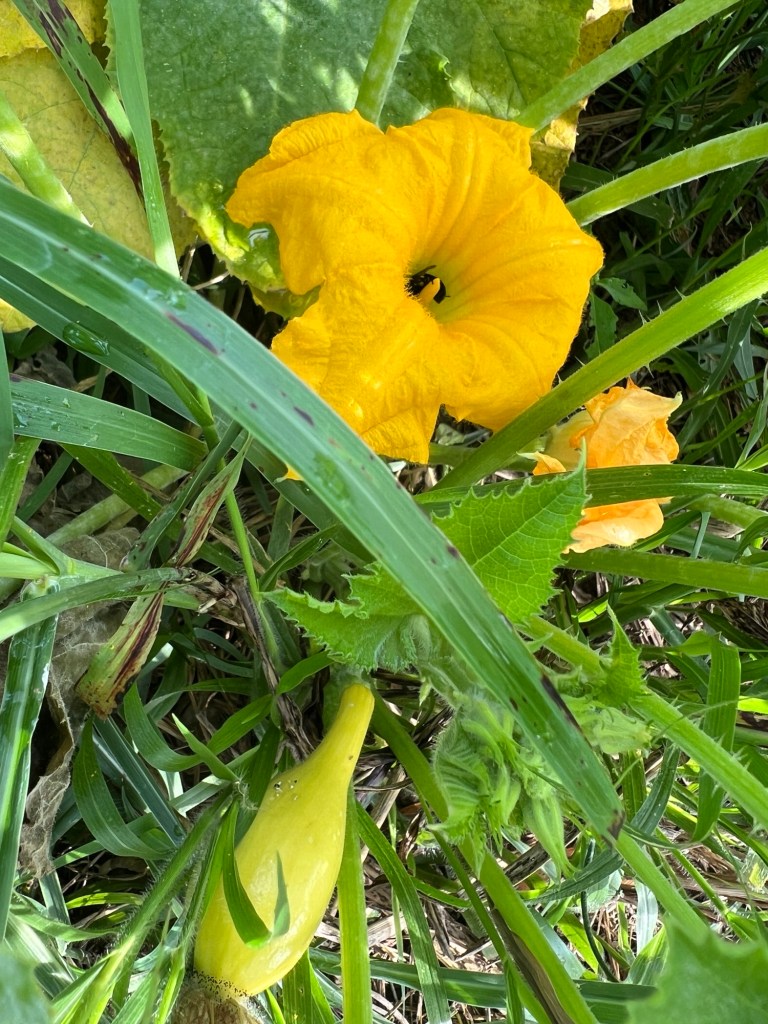
But, by far the star of the show has been our summer squash.  Unbeknownst to us, all 3 of the planters had taken on the task of planting hills of squash.  So—we have been inundated with it.  I’ve made fried squash, boiled squash, stir fry squash, and squash casserole.  We’ve brought bags of squash to our daughter in Lexington and to our neighbor.  And, for those “big’uns” (as my grandparents might have said) we created a new compost pile—a pile of crooked neck gold out in the field that, we hope, will eventually become soil again.  Some of the squash went to our 3 chickens, but they are particular and slow to eat it.  If there is any hope of fruit or worms, they turn their beaks up and snub the squash.

Whenever I watch this miraculous unfolding of vine and leaf and fruit from seed, sun, soil, and water, I am taken aback.  When the small green striped orb in my grandson’s hand becomes as big as his torso in just a few short weeks, and develops into something enough to satisfy several families at a picnic, I am in awe.  When I look at the gorgeous yellow and purple blossoms on the okra stalks morph into green edible pods and the gigantic orange squash blossoms birth cute baby yellow vegetables overnight, I am mesmerized.

The garden becomes a sanctuary.
It all reminds me of a quote—one of my favorite—from Wendell Berry from The Art of the Commonplace: The Agrarian Essays:

“…outdoors we are confronted everywhere with wonders; we see that the miraculous is not extraordinary but the common mode of existence. It is our daily bread. Whoever really has considered the lilies of the field or the birds of the air and pondered the improbability of their existence in this warm world within the cold and empty stellar distances will hardly balk at the turning of water into wine – which was, after all, a very small miracle. We forget the greater and still continuing miracle by which water (with soil and sunlight) is turned into grapes.”

Why I Write

Yesterday a friend sent me an article about writing. He asked me what I thought of it, and here is my writing in response.

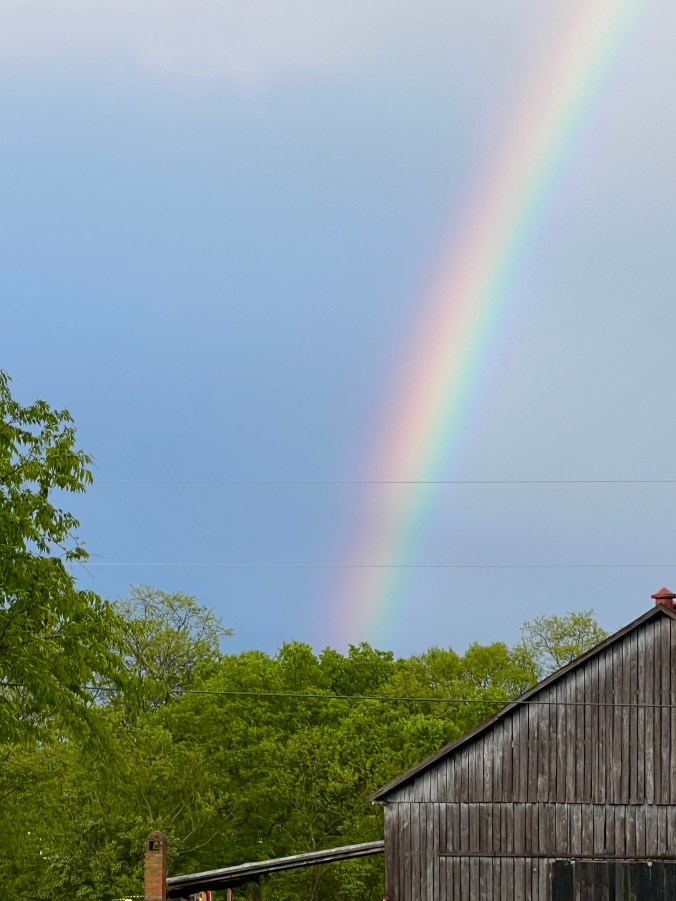
Yesterday’s rainbow from the front porch of our Jessamine farm: The right words, aptly arranged, can turn sun and rain into a rainbow.

I write…

To pray.

To make concrete and visible my thoughts and prayers, which otherwise can seem nebulous and floaty.

To be able to re-collect, re-member.

To organize my life—to do, to list activities, to not forget the details.

To dream and goal.

To communicate with myself or others.

As a ministry—card, text, letter, blog—encouragement, love, concern, admonish, teach.

To express love and concern or disagreement towards resolution with my husband or friends; to prepare for conversation or record a conversation or to think on paper after a conversation.

To record events or dreams or ideas for later reading, remembering or informing family or friends or self.

To be fruitful and multiply; to participate in creation.

Because I like the feel of ink seeping into paper.

Because I like to type.

To leave something behind after I die.

To offer my barbaric yawp to the universe.

To help me figure out riddles—especially through journaling and poetry.

When I write, I make solid the parade of thoughts that are going through my head. But one positive side effect is that the parade slows from fast-paced to pleasurably slower, almost how a stimulant slows an ADHD scattered-ness to a more focused and intelligible state of being.

As a shield and sword for a soldier, so is a pen and words for a writer. The right words, aptly arranged, can turn sun and rain into a rainbow. To be a writer has the potential to be a dealer in life, fire, light, living water, truth, hope, dance, belonging, community, communion, faith, peace, joy, love, and God.

So many writers say they write because they must. To me it is as ordinary as speaking is for a human being. I personally enjoy it more than speaking. I am more true and clear when I write than when I speak.

Wendell Berry’s essay, “Standing by Words,”articulates great respect for words. He states, “We assume, in short, that language is communal, and that its purpose is to tell the truth.” He shows how using words, as in writing, is not a solitary undertaking. I believe in this way writing is God-like—like the perichoretic dance of the Trinity. (Perichoresis being-“a doctrine of the reciprocal inherence of the human and divine natures of Christ in each other.” Merriam-Webster). Writing is a communication with God, myself, the body of Christ, and “the world” simultaneously, when I invite others to read. God and I are always there sharing the words.

Writing is a safe sanctuary for me.

I honor words too much to think of writing as merely desiring to “create meaning in symbolic form.” (Lawrence R. Samuel, “The Psychology of Writing”) Words are powerful—living—more powerful than a symbol in my opinion, when they go from brain to pen to paper to eye to a second brain. Why is Jesus introduced as the Word? How is the Word of God alive? “For the word of God is quick, and powerful, and sharper than any twoedged sword, piercing even to the dividing asunder of soul and spirit, and of the joints and marrow, and is a discerner of the thoughts and intents of the heart.” (Heb. 4:12)

We can be God’s image bearers when we use words to write—especially when they intertwine as warp and weft with sanctified mature thinking and with God’s own words.

Psalm 19 captures this as well. David knew: “7The law of the LORD is perfect, converting the soul: the testimony of the LORD is sure, making wise the simple.

8The statutes of the LORD are right, rejoicing the heart: the commandment of the LORD is pure, enlightening the eyes.

9The fear of the LORD is clean, enduring for ever: the judgments of the LORD are true and righteous altogether.

10More to be desired are they than gold, yea, than much fine gold: sweeter also than honey and the honeycomb.

11Moreover by them is thy servant warned: and in keeping of them there is great reward.”

God wrote the law on stone. God asked his servants to pass on His commands and history/His-Story, through writing. Our lives are forever changed to the core because of writing—because of words.

Words can also be horrifically used, since their power is great, to harm, hurt, deceive, distort. Words were used to change God & humankind’s path, as the serpent & Adam & Eve know. So using words in and of itself is not noble or sanctified; but it is powerful—it is like fire—to be used for warmth and light or for destruction and deceit.

It is a privilege to write, and to share life through writing and reading with others.

Writing can be a place where it is necessary to remove one’s sandals.

Yesterday’s rainbow from our farm

A Good Friday Reflection

As the rain comes down today and I see my packages of seeds awaiting the earth of my garden, being prepared for the death of a seed in the soil, to bring up the resurrection of something new and green–with the un-watering of the sky above; I see the correlation of Jesus’ death on the cross–to bring about a resurrection of hope and redemption offered to us all.

Today our church had a good Friday service in which we contemplate the last 7 words of Christ from the cross. I was asked to participate and I chose Jesus’ words “I thirst” as the focus of my sharing:

I Thirst

By Loretta Goddard, Good Friday 2019

“Jesus, seeing that everything had been completed so that the Scripture record might also be complete, then said, ‘I’m thirsty.’ A jug of sour wine was standing by, someone put a sponge soaked with wine on a javelin and lifted it to his mouth.” John 19:28, 29 (The Msg)

I have been with three people as they died. One, we were trying to keep alive. I gave CPR to him as we awaited an ambulance. The other two were in hospice—one a friend, the other, my father. There were distinct differences in the death we were fighting and the others we were resigned to accept—even welcome.

Jesus’ death was one of acceptance at this point. Those who had eyes to see would even have welcomed it—for it was bringing about their way to redemption! To the Romans and most Jews at the crucifixion, Jesus was the “Dead Man Walking”* —the death row inmate already in the electric chair. To the disciples, the dismayed disciples, it was a horror they were resigned to accept. To Jesus it was the completion of something that began in the garden of Eden when Love, Who wouldn’t let go, began to formulate this plan. Moses wrote about it—the serpent’s head crushed by this woman’s seed* ; as did David, in Psalm 69*, prophesying of this very moment when Jesus would thirst and be offered sour wine.

When I sat with my friend and my father, as they lay dying, I observed that death is:
• an un-breath-ing and
• an un-water-ing.

When we fight death, we start IV lines and push fluids—we know that dehydration is part of dying. When we receive death, ice chips only are offered—or very small sips. Every breath “un-waters.” We offer moistened cotton swabs to cracked lips.

So here on the cross, Living Water was being poured out.

Just a few years prior to this, Jesus sat near a well and told a Samaritan woman: “If you knew the generosity of God and who I am, you would be asking me for a drink, and I would give you fresh, living water.” He said, “Everyone who drinks this water will get thirsty again. Anyone who drinks the water I give will never thirst—not ever. The water I give will be an artesian spring within, gushing fountains of endless life.”*

So now, on the cross, the Giver of Living Water Himself is thirsting. He is dry—parched—poured out—in order to quench our thirst. To bring us the living, gushing waters of saving grace, He is being un-watered with every breath.

Since this “Rock of Ages” gave water for the Israelites in the wilderness* —
Since this God-baby was birthed from amniotic fluid in a stable—
Since coming up from the waters of His baptism* —
Since that day with the woman at the watering well—
Since the dehydrated, un-watered, bleeding woman’s touch of the hem of His garment*-Since the moisture of a kiss of betrayal from Judas to His cheek—
Living, Loving, Water was being poured out.

This Word of God who formed the earth “out of water and through water,”* now allowed Himself, to be un-watered.
Life Himself became “Dead Man Walking.”
The Healer, the Great Physician, was passive. This is the “passion” of the Christ*:                 He became a patient—a hospice patient—submitting to death —
Allowing the un-breath-ing, the un-water-ing, of His death;
to bring us—
to offer us—
fresh living water.

Jesus said, “I thirst” so that we, can be filled with poured out Living Water, and “will never thirst—not ever.”

_________________________________________________________________________________________

*Footnotes:
1. Dead man walking definition: a condemned man walking from his prison cell to a place of execution. https://www.collinsdictionary.com/us/dictionary/english/dead-man-walking
2. Gen 3:15
3. “They gave me poison for food and for my thirst they gave me sour wine to drink.” Ps. 69:2
4. John 4:10 Message, John 4:13/14 Message, italics mine
5. “and all drank the same spiritual drink. For they drank from the spiritual Rock that followed them and the Rock was Christ.” 1 Cor. 10:4
6. Matthew 3:16
7. Matthew 9:20
8. “…the heavens existed long ago, and the earth was formed out of water and through water by the word of God….” 2 Peter 3:5b.
9. “The English word passion takes it root in the Latin, passio, meaning passivity, and that’s its real connotation here. The word “patient” also derives from this. Hence what the Passion narratives describe is Jesus’ passivity, his becoming a “patient”. He gives his death to us through his passivity, just as he had previously given his life to us through his activity.” http://ronrolheiser.com/the-passion-of-jesus/