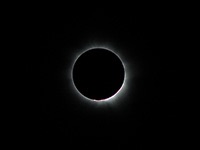
I traveled to our Southern Illinois family farm to observe the April 8, 2024, eclipse. In 2017, I saw 1 minute 28 seconds of totality on this same Illinois farm, but I didn’t know at the time that I could look at totality without my eclipse glasses—so in 2017 I only saw what most of the others outside of totality saw, other than the heightened darkness that came to the environment around me during totality and a complete disappearance of the sun through the dark protective film of my glasses.
This year I discovered that the real show, for me, is both watching totality without eclipse glasses—a true wonder in itself—and just as delightful, watching others, hearing others, simultaneously experiencing this heavenly splendor right next to me.
I watched my 5 year old grandson, Julian, dancing around in celebratory circles, pausing occasionally to put on his special glasses to announce the phases of the disappearing sun: “I can see the moon.” ” It’s just a fingernail!” “It’s a sliver!” “The bees are going back to their beehive.” And during totality, “I can see two stars.” “I actually can see a red “o” on the moon,” he declared when a solar prominence, a burst of plasma, became visible from the bottom of the sun’s corona.
My son-in-law observed, “You can feel it getting dark. Oh gosh, it’s happening.” Then seconds later he exclaimed, “Oh, there it is! There it is, you can see it! Oh, my gosh!” with a similar enthusiasm and excitement as he had when I stood next to him nearly 8 years earlier at the birth of his first child.
My daughter, currently working on her Ph.D. in astronomy and physics, watched in her quiet—the same quiet I saw when she herself was born—a silent, peaceful, pensive observation. Afterwards she imagined the experience of traveling along the path of totality to observe it longer.
My husband, Hule, was instructing the grands when to use their glasses and when they could take them off. He responded to the cooling atmosphere by putting on a sweatshirt and commented on the stars and birds. He tried to help Julian and Hazel appreciate the beauty of the occasion and know its significance.
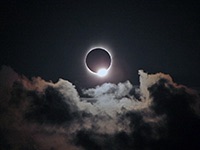
My 87-year-old mother was observing totality for the first time. She reminisced about how in grade school they had made a pinhole projector to observe an eclipse. She commented on the streetlight coming on. And when totality came, she said: “I can’t see it in my glasses…I’m not going to be able to see anything. I’m afraid to take my glasses off.” Then, “Oh. Oh my gosh! It’s spectacular! Are you sure it’s ok? Oh…That’s the brightest diamond I’ve ever seen.” “It is fabulous.” “Oh, I wish we could get a picture of that, it’s so beautiful.”
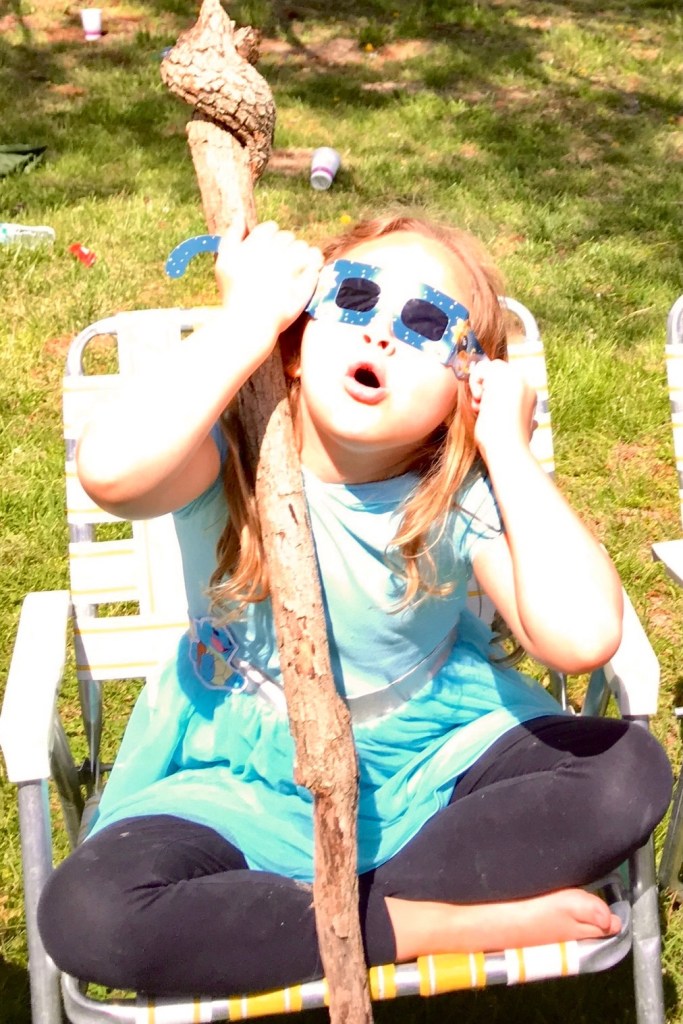
My always animated granddaughter Hazel was the most memorable for me to observe. Just before totality she said, “It’s so dark! It’s literally the smallest sliver!” “Woe!” “Something is happening to the ground! I see the stars. It’s happening, and it’s so dark!” And once totality arrived, she declared, “It’s amazing. It’s making me feel so weird. I feel cold, but I know I’m not. Why is it sunset on all sides? That is amazing, I’ve never seen anything like that!” And about 2 minutes in, Hazel requested, “Everyone be quiet, I want to see if I can listen.”
(…And a little child shall lead them…) …
Then, the light came rushing back with a streak.
We were all changed in 4 minutes and 7.5 seconds.
Hazel’s amazement and celebration continued. “Wow, I’ve never seen that…” breathing deeply, nearly panting. (“Except in a book,” Jude added.) Hazel bent at the knees then stood straight up, head to the heavens, eyes closed, and she laughed and laughed. Papa Hule came over and stroked her head. She squealed in delight. “I’m sooo happy!” Twirling around and around she repeated, “That’s the first time I’ve ever seen totality in my life, and I’m 7!”
The way I remember what people said and how they looked, is that I had 4 cameras going. One iPhone was on a tripod with a solar filter, watching the sun, but “listening in” on conversations. Another, iPhone was propped up across the way, observing the observers. I held one iPad on my lap with a solar lens attached and had another “naked” iPhone in my hand. I could not otherwise have taken it all in and remembered it as accurately.
For me the eclipse was impressionistic, poetic:
Diminution of the sun—one bite at a time.
Twilight twice in one half hour period,
And the sudden darkness,
Expected, but only known when experienced.
Then,
A Communal gasp of Awe.
A narrow Ring of bright cool light dancing around a perfect dark disc.
The large bright creation that keeps us alive and feeling “safe” on earth is covered up by our nightlight.
Our heat and light,
Our stove and lamp,
Is overshadowed by
Our nighttime companion,.
It becomes one with its companion.
There is a union of them with one another,
And them with us.
Creatures around us are bewildered and we think of our early ancestors who were taken aback, astonished, surprised, when dark descended during full day and when “Brother Sun and Sister Moon” fused.
Light is foundational to our existence. We are drawn to the light of the stars. We bask in sunshine, observe sunsets and sunrises. These mark our days. Despite years of discoveries, so many mysteries remain concerning light.
Jesus called Himself the Light of the world. He instructed us not to allow our light to be hidden. He tells us to let our light shine.

God has hidden shadows, metaphors, similes, everywhere, since the beginning of time. What is the meaning here?
With light comes dark. When Light departs, dark descends. Darkness covered the earth during the day when Christ died: from noon until 3 o’clock.
My daughter, Julianne, an astrophysicist, must include “dark matter” in her mathematical equations to simulate theoretical galaxy formations.
God, is there a meaning here in this eclipse? You drew an X over the U.S. with the last two eclipses observable to us. Our Illinois farm was in the center of the X. But, like contrails above, You are forever drawing signs in the sky. To focus on this one, these two, is it egocentric? It is so special to us because we in the U.S. get to see it—it has come to us. Thank you!

St. Augustine said of God’s ways: “We are speaking of God; what marvel, if you do not understand? For if you understand, it is not God.”
“Total solar eclipses typically happen every one to three years somewhere around the globe, but the events are often only visible from Earth’s poles or from the middle of the ocean.” (CBSNews.com)
So, maybe it is a reminder that we are not in charge of light and not in control of moon and sun. Maybe it is a way to remember our sameness and lay aside our differences while we gaze at the wonder of it all.
And though the sun and moon are important, light was brought forth on the first day, before the sun, moon and stars appeared on the fourth. (Gen. 1:14-18) These latter lights were said to bring time—day and night, and for signs and seasons. One to govern the night and one the day, and to separate light from darkness.
But as glorious as it is to observe the lights above, it seems that they are not necessary to eternity. In the mystery of the Word we get a glimpse of something even brighter and more spectacular—worthy of our Communal Gasp of Awe:
“Then I saw ‘a new heaven and a new earth,’ for the first heaven and the first earth had passed away…The city does not need the sun or the moon to shine on it, for the glory of God gives it light, and the Lamb is its lamp. The nations will walk by its light, and the kings of the earth will bring their splendor into it. On no day will its gates ever be shut, for there will be no night there.” Revelation 21: 1, 23-25, NIV
There is nothing that can eclipse His Light!
 Our Jessamine Farm