A Communal Gasp of Awe

Photo Credit: Rick Fienberg

I traveled to our Southern Illinois family farm to observe the April 8, 2024, eclipse.  In 2017, I saw 1 minute 28 seconds of totality on this same Illinois farm, but I didn’t know at the time that I could look at totality without my eclipse glasses—so in 2017 I only saw what most of the others outside of totality saw, other than the heightened darkness that came to the environment around me during totality and a complete disappearance of the sun through the dark protective film of my glasses.

This year I discovered that the real show, for me, is both watching totality without eclipse glasses—a true wonder in itself—and just as delightful, watching others, hearing others, simultaneously experiencing this heavenly splendor right next to me.

 I watched my 5 year old grandson, Julian, dancing around in celebratory circles, pausing occasionally to put on his special glasses to announce the phases of the disappearing sun: “I can see the moon.”  ” It’s just a fingernail!”  “It’s a sliver!” “The bees are going back to their beehive.”   And during totality, “I can see two stars.”   “I actually can see a red “o” on the moon,” he declared when a solar prominence, a burst of plasma, became visible from the bottom of the sun’s corona.

My son-in-law observed, “You can feel it getting dark.  Oh gosh, it’s happening.”  Then seconds later he exclaimed, “Oh, there it is!  There it is, you can see it! Oh, my gosh!” with a similar enthusiasm and excitement as he had when I stood next to him nearly 8 years earlier at the birth of his first child.

My daughter, currently working on her Ph.D. in astronomy and physics, watched in her quiet—the same quiet I saw when she herself was born—a silent, peaceful, pensive observation.  Afterwards she imagined the experience of traveling along the path of totality to observe it longer.

My husband, Hule, was instructing the grands when to use their glasses and when they could take them off.  He responded to the cooling atmosphere by putting on a sweatshirt and commented on the stars and birds.  He tried to help Julian and Hazel appreciate the beauty of the occasion and know its significance.

My 87-year-old mother was observing totality for the first time.  She reminisced about how in grade school they had made a pinhole projector to observe an eclipse.  She commented on the streetlight coming on.   And when totality came, she said: “I can’t see it in my glasses…I’m not going to be able to see anything. I’m afraid to take my glasses off.” Then, “Oh.  Oh my gosh!  It’s spectacular!  Are you sure it’s ok? Oh…That’s the brightest diamond I’ve ever seen.”  “It is fabulous.”  “Oh, I wish we could get a picture of that, it’s so beautiful.”
Photo Credit: Rick Fienberg

My always animated granddaughter Hazel was the most memorable for me to observe.  Just before totality she said, “It’s so dark! It’s literally the smallest sliver!”  “Woe!”  “Something is happening to the ground!  I see the stars.  It’s happening, and it’s so dark!” And once totality arrived, she declared, “It’s amazing.  It’s making me feel so weird.  I feel cold, but I know I’m not. Why is it sunset on all sides? That is amazing, I’ve never seen anything like that!”  And about 2 minutes in, Hazel requested, “Everyone be quiet, I want to see if I can listen.”

(…And a little child shall lead them…)  …
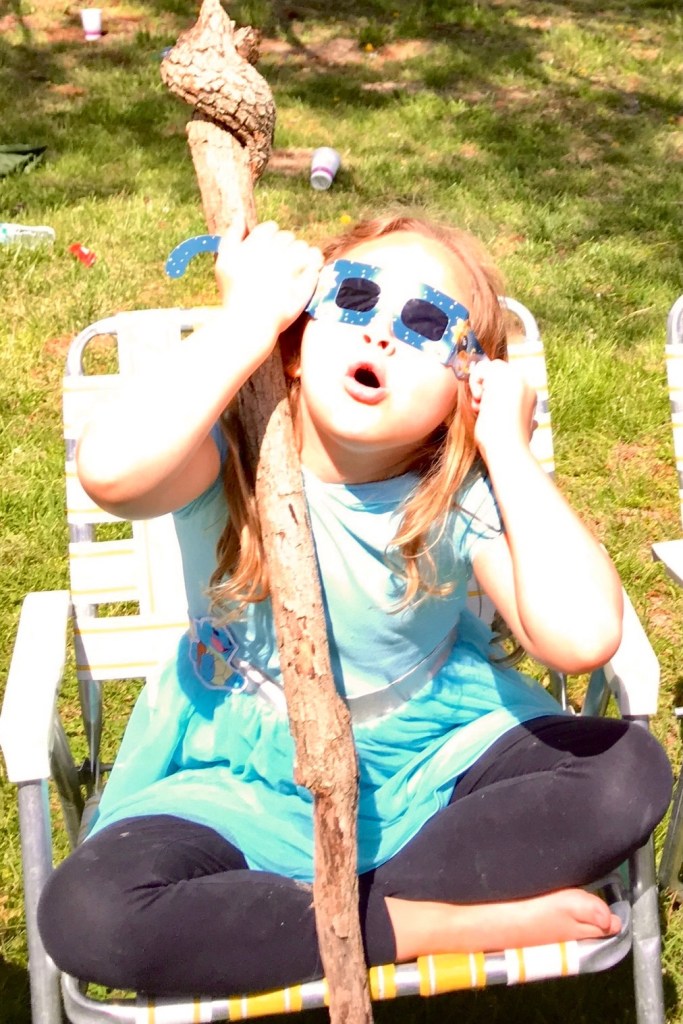
Hazel in awe

Then, the light came rushing back with a streak.

We were all changed in 4 minutes and 7.5 seconds.

Hazel’s amazement and celebration continued. “Wow, I’ve never seen that…” breathing deeply, nearly panting.  (“Except in a book,” Jude added.)  Hazel bent at the knees then stood straight up, head to the heavens, eyes closed, and she laughed and laughed.  Papa Hule came over and stroked her head.  She squealed in delight.  “I’m sooo happy!” Twirling around and around she repeated, “That’s the first time I’ve ever seen totality in my life, and I’m 7!” 

The way I remember what people said and how they looked, is that I had 4 cameras going.  One iPhone was on a tripod with a solar filter, watching the sun, but “listening in” on conversations.  Another, iPhone was propped up across the way, observing the observers. I held one iPad on my lap with a solar lens attached and had another “naked” iPhone in my hand.  I could not otherwise have taken it all in and remembered it as accurately. 

For me the eclipse was impressionistic, poetic:

Diminution of the sun—one bite at a time.

Twilight twice in one half hour period,

And the sudden darkness,

Expected, but only known when experienced.

Then,

A Communal gasp of Awe.

A narrow Ring of bright cool light dancing around a perfect dark disc.

The large bright creation that keeps us alive and feeling “safe” on earth is covered up by our nightlight.

Our heat and light,

Our stove and lamp,

Is overshadowed by

Our nighttime companion,.

It becomes one with its companion.

There is a union of them with one another,

And them with us.


Creatures around us are bewildered and we think of our early ancestors who were taken aback, astonished, surprised, when dark descended during full day and when “Brother Sun and Sister Moon” fused. 

Light is foundational to our existence.  We are drawn to the light of the stars.  We bask in sunshine, observe sunsets and sunrises.  These mark our days.  Despite years of discoveries, so many mysteries remain concerning light.

Jesus called Himself the Light of the world.  He instructed us not to allow our light to be hidden.  He tells us to let our light shine.

Photo I took during 2024 eclipse

God has hidden shadows, metaphors, similes, everywhere, since the beginning of time.  What is the meaning here?

With light comes dark. When Light departs, dark descends. Darkness covered the earth during the day when Christ died: from noon until 3 o’clock. 

My daughter, Julianne, an astrophysicist, must include “dark matter” in her mathematical equations to simulate theoretical galaxy formations.

God, is there a meaning here in this eclipse?  You drew an X over the U.S. with the last two eclipses observable to us.  Our Illinois farm was in the center of the X.  But, like contrails above, You are forever drawing signs in the sky.  To focus on this one, these two, is it egocentric? It is so special to us because we in the U.S. get to see it—it has come to us. Thank you!

Photo I took while retreating at Abbey of Gethsemani in KY

St. Augustine said of God’s ways: “We are speaking of God; what marvel, if you do not understand? For if you understand, it is not God.”

“Total solar eclipses typically happen every one to three years somewhere around the globe, but the events are often only visible from Earth’s poles or from the middle of the ocean.” (CBSNews.com)

So, maybe it is a reminder that we are not in charge of light and not in control of moon and sun.  Maybe it is a way to remember our sameness and lay aside our differences while we gaze at the wonder of it all.

And though the sun and moon are important, light was brought forth on the first day, before the sun, moon and stars appeared on the fourth. (Gen. 1:14-18) These latter lights were said to bring time—day and night, and for signs and seasons.  One to govern the night and one the day, and to separate light from darkness. 

But as glorious as it is to observe the lights above, it seems that they are not necessary to eternity.  In the mystery of the Word we get a glimpse of something even brighter and more spectacular—worthy of our Communal Gasp of Awe:

“Then I saw ‘a new heaven and a new earth,’ for the first heaven and the first earth had passed away…The city does not need the sun or the moon to shine on it, for the glory of God gives it light, and the Lamb is its lamp.  The nations will walk by its light, and the kings of the earth will bring their splendor into it.  On no day will its gates ever be shut, for there will be no night there.”   Revelation 21: 1, 23-25, NIV

There is nothing that can eclipse His Light!

When I’m 64

Happy Birthday me! I am turning 64.

Me contemplating life at age 3 months

I have started humming this Beetles song lately: “Will you still need me, will you still feed me, when I’m 64.” I remember sitting in church when I was in Junior High school figuring out how old I would be in the year 2000—because that seemed so far in the future—like the Jetsons! I would be 40! Nearly ready for the nursing home, I thought at the time.

My Jr. High days

I recently went to the funeral of our pastor from my teenage years. What a legacy he had! Brother Delbert Wells (and his wife Beverly) were such a gift to me and so many more that God put in their path. He was like the pastor in the Jesus Revolution movie. In my hometown of Springfield, IL he opened his little church of Bethel to the hippies of the day. I was a Jr. hippie 🙂 ; old enough to wear bell bottoms and say, “Make love not war”, and have “Flower Power” written on my school notebooks and buy my blacklight posters from our local headshop called “Penny Lane”. Others in our church, and at our downtown Christian coffeehouse named LSD (for Lighter Side of Darkness), were “major” hippies just saved from the world of drugs and deep darkness. Brother and Sister Wells gave us respect, grace, a place in God’s Church and nurtured our individual callings. Their surrendered lives led us closer to God’s loving and perfect plan for our lives.

My early teen years

On the way home from Brother Wells’ funeral, I listened to The Great Divorce by C.S. Lewis. The following is my journal writing as I contemplated legacy and end of life, time passages, the final judgement and heaven:

“On the way down today, I listened to The Great Divorce. The last time I read it, I could barely understand the symbolism. Today it was rich. I thought of how clever of CS to illustrate all of us and thought that an evaluation of certain questions as the book is being read would be helpful: “Who are you in the story?” and “Which characters are your significant others in the story?” and “How can this work inform you on how to live and not live?”

I recall:

The inexplicable addiction to the Red Lizard of Lust which turned to a White Stallion of Desire after a difficult death to lust, bringing a rose brightness up the Mountain of Light.

The woman full of other-love that was really self-love in disguise, supposed love for son trumping love for God.  (Is this me?)

The theologian not wanting to let go of the questioning, the philosophizing, the open-endedness even after arrival in the surety of heaven. (Is this me?)

The teacher needing to teach for identity.

The painter wanting to paint heaven, but not to capture heaven’s radiance, but for his own reputation. (Is this me as poet/journaler/blogger/writer? Will I lay down my pen in heaven?)

The tragedian/disappearing dwarf chained and “their” wife—all glorious and exalted coming to them humbly beginning with apology but with the challenge to give up a quest for pity which only squelches joy.

The wife who always wanted her husband just to dominate/control/chide him.

George McDonald as CS’ guide—mentor—like Virgil & Beatrice for Dante.

The solidity of heavenly things and transparency of our un-surrendered selves.

Help me not to love learning most, but to love learning about YOU! Help me to lay down my search once you are found. Help me to lay down my “Religion” once I am in Your arms—Your sight—Your presence fully and eternally.

Help me now, Lord, to live a life so pleasing that I will have let go of all of “me” that is not under your Lordship.  Help me to examen—examine—and give me courage to let go—to hold on only to You and Your ways and Your will and desire for You!!  I know that is where peace is and truth and life and Light.  That is my only place of True Safety—True Love.”

And so, now that I’m turning 64, I continue praying this journal prayer. I pray that I will live well. I pray that I will serve well. I pray that I will age well. I pray that I will end well!

…Pray this along with me.

Why I Write

Yesterday a friend sent me an article about writing. He asked me what I thought of it, and here is my writing in response.

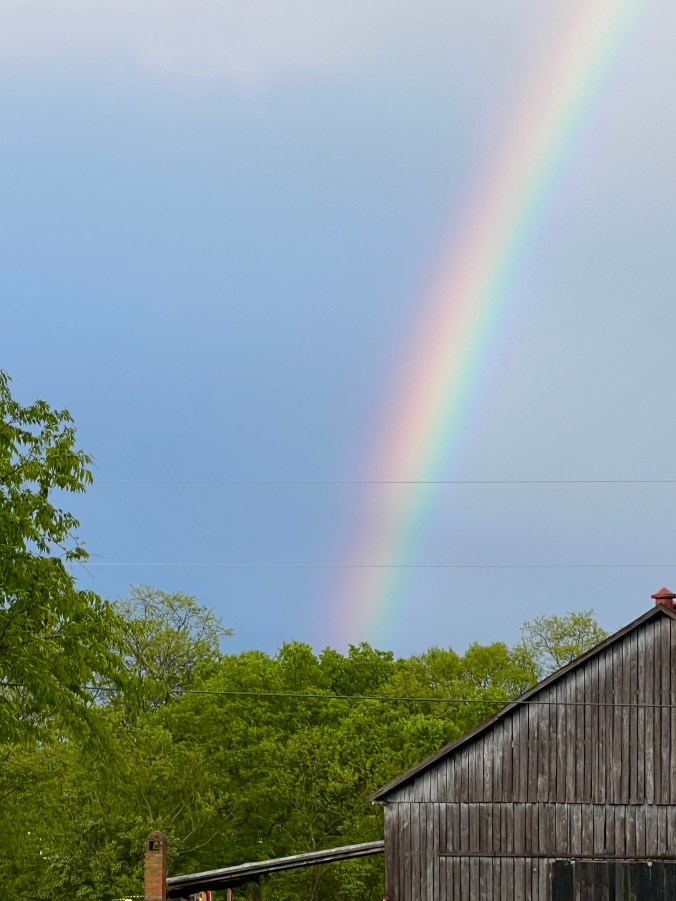
Yesterday’s rainbow from the front porch of our Jessamine farm: The right words, aptly arranged, can turn sun and rain into a rainbow.

I write…

To pray.

To make concrete and visible my thoughts and prayers, which otherwise can seem nebulous and floaty.

To be able to re-collect, re-member.

To organize my life—to do, to list activities, to not forget the details.

To dream and goal.

To communicate with myself or others.

As a ministry—card, text, letter, blog—encouragement, love, concern, admonish, teach.

To express love and concern or disagreement towards resolution with my husband or friends; to prepare for conversation or record a conversation or to think on paper after a conversation.

To record events or dreams or ideas for later reading, remembering or informing family or friends or self.

To be fruitful and multiply; to participate in creation.

Because I like the feel of ink seeping into paper.

Because I like to type.

To leave something behind after I die.

To offer my barbaric yawp to the universe.

To help me figure out riddles—especially through journaling and poetry.

When I write, I make solid the parade of thoughts that are going through my head. But one positive side effect is that the parade slows from fast-paced to pleasurably slower, almost how a stimulant slows an ADHD scattered-ness to a more focused and intelligible state of being.

As a shield and sword for a soldier, so is a pen and words for a writer. The right words, aptly arranged, can turn sun and rain into a rainbow. To be a writer has the potential to be a dealer in life, fire, light, living water, truth, hope, dance, belonging, community, communion, faith, peace, joy, love, and God.

So many writers say they write because they must. To me it is as ordinary as speaking is for a human being. I personally enjoy it more than speaking. I am more true and clear when I write than when I speak.

Wendell Berry’s essay, “Standing by Words,”articulates great respect for words. He states, “We assume, in short, that language is communal, and that its purpose is to tell the truth.” He shows how using words, as in writing, is not a solitary undertaking. I believe in this way writing is God-like—like the perichoretic dance of the Trinity. (Perichoresis being-“a doctrine of the reciprocal inherence of the human and divine natures of Christ in each other.” Merriam-Webster). Writing is a communication with God, myself, the body of Christ, and “the world” simultaneously, when I invite others to read. God and I are always there sharing the words.

Writing is a safe sanctuary for me.

I honor words too much to think of writing as merely desiring to “create meaning in symbolic form.” (Lawrence R. Samuel, “The Psychology of Writing”) Words are powerful—living—more powerful than a symbol in my opinion, when they go from brain to pen to paper to eye to a second brain. Why is Jesus introduced as the Word? How is the Word of God alive? “For the word of God is quick, and powerful, and sharper than any twoedged sword, piercing even to the dividing asunder of soul and spirit, and of the joints and marrow, and is a discerner of the thoughts and intents of the heart.” (Heb. 4:12)

We can be God’s image bearers when we use words to write—especially when they intertwine as warp and weft with sanctified mature thinking and with God’s own words.

Psalm 19 captures this as well. David knew: “7The law of the LORD is perfect, converting the soul: the testimony of the LORD is sure, making wise the simple.

8The statutes of the LORD are right, rejoicing the heart: the commandment of the LORD is pure, enlightening the eyes.

9The fear of the LORD is clean, enduring for ever: the judgments of the LORD are true and righteous altogether.

10More to be desired are they than gold, yea, than much fine gold: sweeter also than honey and the honeycomb.

11Moreover by them is thy servant warned: and in keeping of them there is great reward.”

God wrote the law on stone. God asked his servants to pass on His commands and history/His-Story, through writing. Our lives are forever changed to the core because of writing—because of words.

Words can also be horrifically used, since their power is great, to harm, hurt, deceive, distort. Words were used to change God & humankind’s path, as the serpent & Adam & Eve know. So using words in and of itself is not noble or sanctified; but it is powerful—it is like fire—to be used for warmth and light or for destruction and deceit.

It is a privilege to write, and to share life through writing and reading with others.

Writing can be a place where it is necessary to remove one’s sandals.

Yesterday’s rainbow from our farm

Thanksgiving

Thanksgiving. Thanks Giving. Giving Thanks.

It seems a bit vaporous on Thanksgiving day to just say, “I’m thankful.” On this day we are good at inquiring and responding to questions asking for what we are thankful. Many of us ask family around the table, and even kids in school, to name what each person is thankful for. My grandson, Julian (Jude), brought home a Thanksgiving craft wheel this week that he made in his 4 year old “Little Elks” preschool class . He could spin it, pointing to things on his list. His chosen responses consisted of Candy, Balls, and Mommy :).

I believe it is important to take time to be thankful and this holiday gives space for that. Right before we begin to write Christmas lists for what we want, and go into the biggest spending sprees of the year, we look around and evaluate the good we already have. In sincere communal gratitude one can almost sense the forgotten beautiful wisps of “Content”, “Enough”, “Satisfied”.

But, implicit in both thanking and in giving, is a direct object and indirect object. I am not a language scholar (in fact, I’m sure I’ve already dangled a few participles above) but I believe both of these verbs, give and thank, are transitive: “characterized by having or containing a direct object” (merriam-webster.com). “A transitive verb, used with a direct object, transmits action to an object and may also have an indirect object, which indicates to or for whom the action is done.” (cliffsnotes.com) In the same way that we don’t just buy birthday or Christmas gifts, or write thank you notes, and give them to nobody in particular, it completes the intention and benefit of giving and thankfulness to direct our gratitude to someone or Someone.

So, in this short blog post I want to remind us all this day, and every day, to name our direct and indirect objects, the target and reason and catcher of our thanksgiving. Yes, it includes family and friends, but also, let’s address our ultimate Provider. Name the Lord. Direct words to Jesus. Thank God. Acknowledge that, “Every good and perfect gift is from above, coming down from the Father of the heavenly lights, who does not change like shifting shadows.” (James 1:17).

I end this post with a prayer of Thanksgiving from the Book of Common Prayer and invite you and your loved ones to use it, or any prayers from your hearts, to address the Giver, the Lover, the Lord Christ—to name both for what, and to Whom, you give thanks.

A LITANY OF THANKSGIVING*

Let us give thanks to God our Father for all his gifts so freely bestowed upon us:

For the beauty and wonder of your creation, in earth and sky and sea,

      We thank you, Lord.

For our daily food and drink, our homes and families, and our friends,

      We thank you, Lord.

For minds to think, and hearts to love, and hands to serve,

      We thank you, Lord.

For health and strength to work, and time to rest and worship,

      We thank you, Lord.

For all who are patient in suffering and faithful in adversity,

      We thank you, Lord.

For all who earnestly seek after truth, and all who labor for justice,

      We thank you, Lord.

For all that is good and gracious in the lives of men and women, revealing the image of Christ,

      We thank you, Lord.

For the communion of saints, in all times and places,

We thank you, Lord.

Above all, we give you thanks for the great mercies and promises given to us in Christ Jesus our Lord;

      To him be praise and glory, with you, O Father,

      and the Holy Spirit, now and for ever. Amen

*https://bcp2019.anglicanchurch.net/wp-content/uploads/2022/10/BCP-2019-MASTER-5th-PRINTING-05022022-3.pdf

The Coronavirus…Is it Real?

“I see it, I see it,” said Hazel, pointing to my small paisley decorated retractable tape measure.

“What do you see?” I asked.

“The virus. I see the virus!”

For over a year now our lives have been rerouted and turned upside down because of “the virus”. Hazel has often referred to “the sickness”. Hazel is four and, despite being her grandma, I declare she is nigh a genius. 🙂 Her mind is continually picking up things said, things seen, things smelled, and integrating them quickly into her vast repertoire of knowledge, then easily figuring out a way to express those new discoveries. So, like a true nurse educator and science lover, I said,

“Oh, nobody can see the virus except with a very powerful microscope. But Hazel, here… (I pulled up the image on my phone), this is the coronavirus. See, they made a picture of what it looks like under a microscope.”

PHIL.cdc.gov

Even Julian, my curious two year old grandson, came near to see it too. They both studied it.

Hazel paused for a while…..

“But, is it real?” she asked.

“Well, this is a picture of it, but this is not the actual virus here in my hands.” I said.

“What?” answered Hazel.

“Well–like when I have a picture of you–see?” I showed her a picture of herself on my phone. “That is a picture of you. You are real, but that is not you. You are real, but that is just a picture of you.”

At this point I was even getting confused. We started taking pictures of things with the iPhone and then showing the real thing next to the picture of the real thing, but she kept saying,

“I don’t know what you’re talking about.”

This was the first time I had encountered Hazel being stumped and it surprised me.

But it got me thinking. Thinking about this world she’s raised in. Watching TV, animation and news come into the living room back to back. Every Christmas and Easter we walk the tightrope of whether Santa or the Easter Bunny are real. Then there’s God and Jesus. We read Bible stories and then Paw Patrol stories, Anatomy books and books of fairies, then of angels. We go to church and say grace at meals and even whisper prayers in the air from time to time:

“Is there really a Chase and Rubble? Is that really what my body looks like inside? Are angels real? Are fairies? Is God really real? Is Jesus God?

What is real?

And, how do you explain that to a four year old. And how do we even know that ourselves?

Because of art and books and movies and TV, and video games, anyone’s imagination can become visible. So, anything and everything seems real when brought to the vision and hearing–especially to that of a child. Is this touching on why Jesus said:

“Let the little children come to me, and do not hinder them, for the kingdom of God belongs to such as these. Truly I tell you, anyone who will not receive the kingdom of God like a little child will never enter it.”

Children are sponges and readily receive the reality of the kingdom of God. Even great thinkers like C.S. Lewis and G.K. Chesterton entered kingdom realities through the portals/wardrobes of childhood’s believing. To my logical mind, this seems reckless. Hazel has imaginary friends and talks to them. Who knows, but that to her, our prayers seem like talking to imaginary friends. We have “pictures” of Jesus, but we explain that’s not really a photograph or even painting of the real Jesus–nor is the picture the actual Jesus himself. And then there comes the explaining that not all people even believe that God is real. And not all people believe Jesus is God. He wants us to come to him in faith. Our belief in him is what takes us to the doorknob to open the door and “see him”.

But this is not just a God conundrum. There are some who do not believe there is a coronavirus and they live as though there isn’t. There are consequences to that action; but the virus doesn’t exist or not exist, infect or not infect, its substance and reality do not change, based on whether we believe strongly enough in it. It just is what it is.

Hazel and Julian in the time of “the virus”

The God of the Old Testament introduced himself as, “I Am Who I Am.”

The substance, the reality of God, does not rely on our belief, but our faith in him opens or shuts the door to our friendship with him. Jesus asked, “Who do people say I am?” and “Who do the crowds say I am?” Then Jesus asks the REAL question: “But what about you? … Who do you say I am?”

Jesus introduced himself as I Am:

“I am the bread of life.”

“I am the light of the world.”

“I am the door.”

“I am the good shepherd.”

“I am the vine, you are the branches.”

“I am the way, the truth, and the life. No one comes to the Father except through me.”

“I am the resurrection and the life. He who believes in me, though he may die, he shall live. And whoever lives and believes in me shall never die. Do you believe this?” he asked.

Do you believe this? Is God real? … even if we don’t have a microscopic close up photo of him? Are you living like God is real? Today Jesus asks each one of us what he asked his disciple:

“But what about you? Who do you say I am?”

Scriptures referenced above include Exodus 3:14, Mark 8:27, Luke 9:18, Matthew 16:15, Mark 8:29, Luke 9:20, John 6:35, John 8:12, John 10:9, John 10:11, John 11:25, 26, John 14:6, John 15:5

Covid-19 from the farm

img_3375

I began the morning while it was still dark–6:30ish a.m.

A quiet house

Heating blanket on

Furnace catching up from nighttime turn down to morning turn up

67 to 72 degrees

No coffee yet

Papers shuffled

Nest made

Bible at side…waiting

Candle lit

A week ahead

The new way…

Last week I was “off” from babysitting because it was my daughter’s spring break; but the whole world is shuttering now for the novel coronavirus–isolation, lockdown, shelter in place….  On Wilmore Anglican Church’s Sunday morning sermon Facebook feed, Hule echoed musings by Andy Crouch who was referencing Osterholm, an infectious disease specialist, asking:  Is this a blizzard? a winter? or an ice age? We went into this thinking–a blizzard–just a few weeks.  Now it’s apparent it will be at least a winter.  But with political stalemates and the tenacity of those numbers and climbing curve, and the falling stock market, we are all wondering if it’s ushering in a new metaphorical ice age.

Lord, You are in control and You are good!  Hule’s quote of “Granny Rene” is right:

“God is God.  God is good.  And God loves us!”  This is what we know.

But God, what are you up to?

I am reading the Old Testament book of Job.  What God was up to in Job was not apparent to Job’s children, his employees, his country, his wife, his friends–not even to Job; but from heaven’s perspective it was made clear.  In human eyes we might say, “That’s not fair!”  “I don’t get it!”  But God is God.  His ways don’t have to be explained or justified.  He is sovereign.  We are not equipped to push back the works of God, or meant to question them.  God allows Satan, with limits, to seemingly wreak havoc at times for His own purposes.  Jesus himself experienced that:

His corona–His crown–His thorny, blood-stained crown, because God loves us;

His isolation and His own body shut-up, quarantined–in a cave, a tomb,

While hell was harrowed.

And Job lost it all:  his livelihood; his house and farm; his children and his wealth.  When he faced the sudden calamity, the sudden blizzard, he said:

Naked came I from the womb

Naked shall I return.

The Lord it is who gives

and the Lord takes away.

Blessed be the name of the Lord!

And “In all this Job did not sin or charge God with wrong.”  God is good.

Then entered winter.

Satan was given even more permission and Job’s body was ravaged.  Was it a novel virus that was unleashed on him?  His wife told him to “curse God and die.”  And Job said, “Shall we receive good from God and shall we not receive evil?”  “And in all this Job did not sin with his lips.”  When we never acknowledged that it was the Lord who gave and it was the Lord who provided good all along–when we think it was our own goodness that brought it about—besides being extremely blind and arrogant–we don’t know what we don’t know.

How is it that we believe so often that we create the good but it is God who brings the bad?  And how is it that we believe it’s all about us?  That our purposes are at the center instead of God’s purposes?  Do we fault God for acting like God?  …for putting His purposes above our own?

The suddenness of Job’s losses brought on a stunning: a sitting together on the ground in silence together for 7 days before a word was uttered.  A 7 day silence.  7 days of ground-sitting together before a word was spoken.  Something gigantic is there–something absent from our culture; a language few of us speak!  A practice foreign to our list of possibilities: sitting together 7 days in utter silence.

Be still and know that I am God

Be still and know that I am

Be still and know that I

Be still and know that

Be still and know

Be still and

Be still

Be…

It’s that empty, wordless nothingness—

Silence

Stillness

No raging

No questioning

No figuring out

No philosophizing

No doctoring

No leading

No consulting

No data collecting

But sitting still with the circumstance together with a few friends in wordlessness–on the ground:

We are but dust and to dust we will return.

Naked came we–Naked shall we return–Blessed be the name of the Lord!

This is part of practicing Lent.

And what we always know is:

God is God.

God is good.

God loves us.