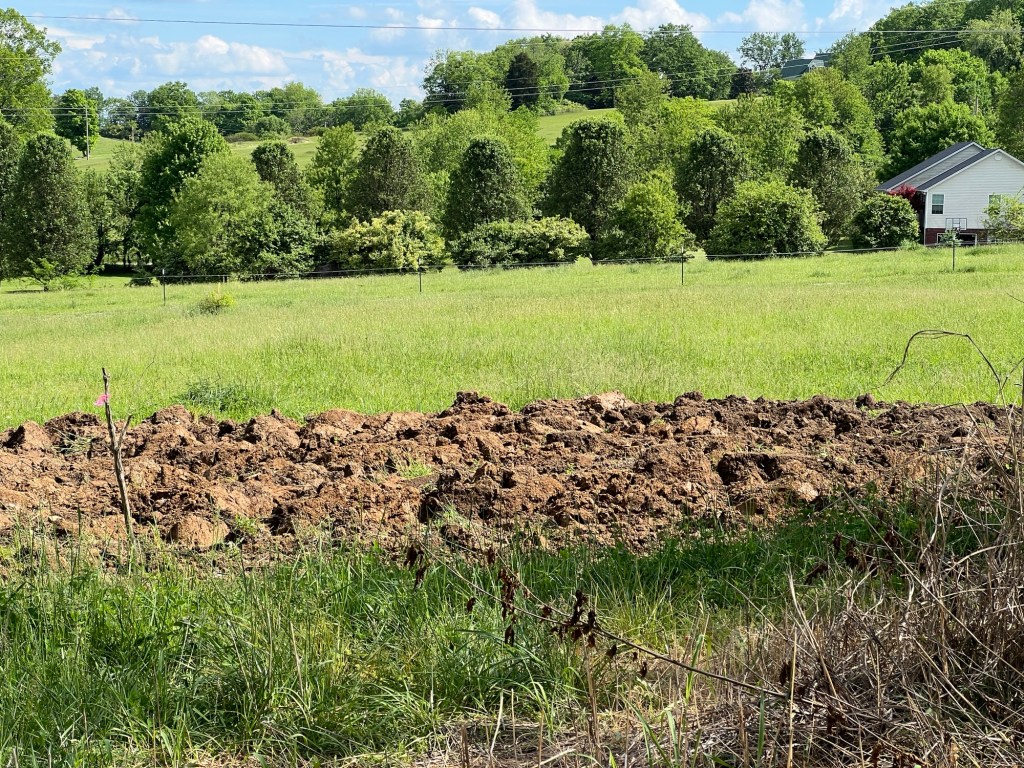
Our garden this year started slowly. We had arranged for a local farmer to till the ground for us in March, but that fell through, and we were at mid-April, the typical last frost time, with a handful of seed packets but without a plowed garden bed. I’ve read about the no-till garden options, and I wish I would have done that, but I hadn’t, so we were at a standstill.
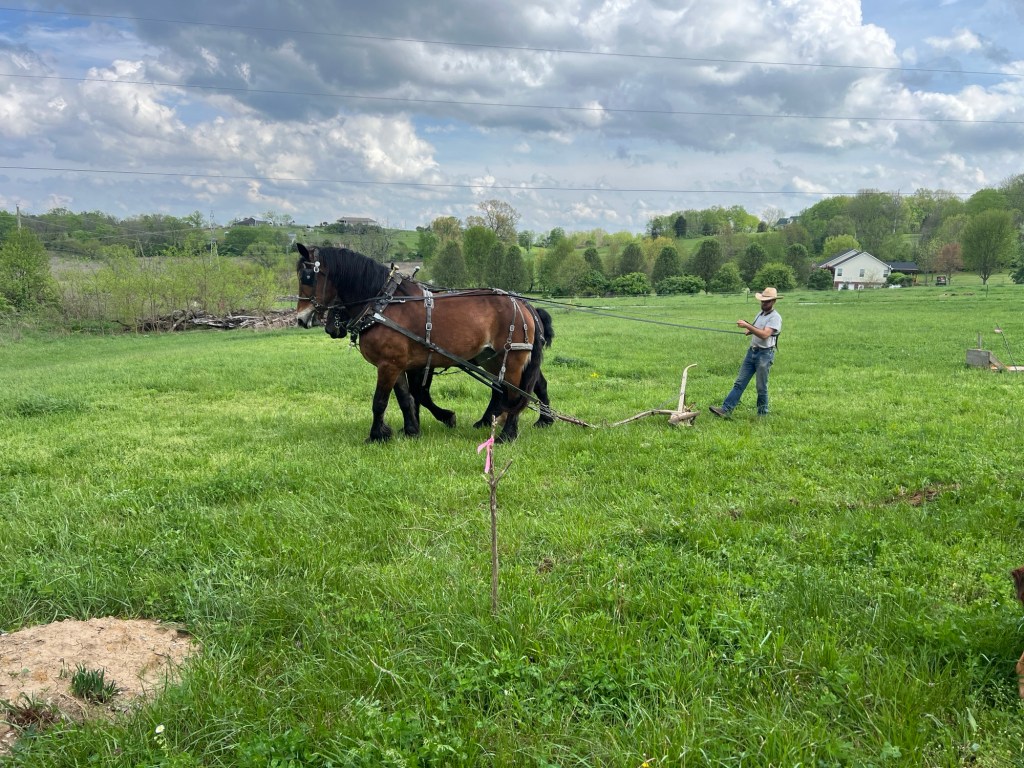
That is, until our new neighbor offered to come over and till the garden with his workhorse and plow! I felt like a character in a Wendell Berry novel living in Port William. Even our grandkids got to watch!
Then Hule, our daughter, and I, all took turns the next few weeks planting what we wanted from our seed selections. I wanted squash and okra. Hule also planted watermelon and pumpkins. Sarah planted some of the more exotic and heirloom choices.
At first there was very little to show for our efforts. Then there were weeks of drought and hot weather, and we got a sprinkler. We likely over-watered because our water bill spiked up to over $100 from our typical $44/mo. There went our “saving money” by having a garden.
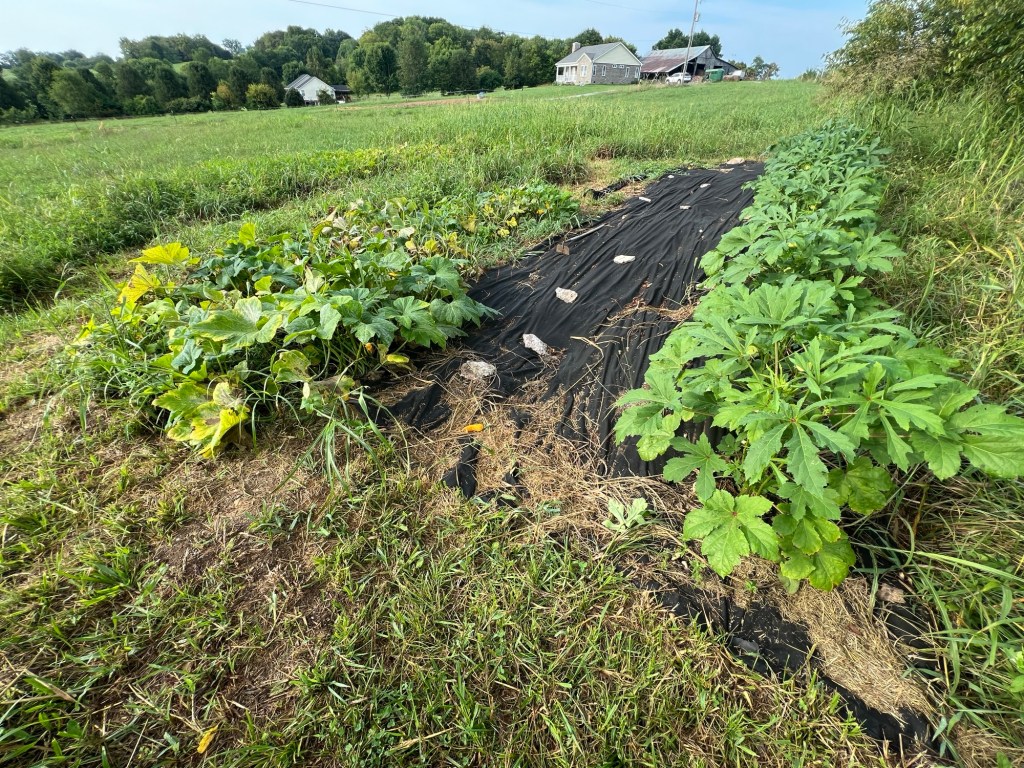
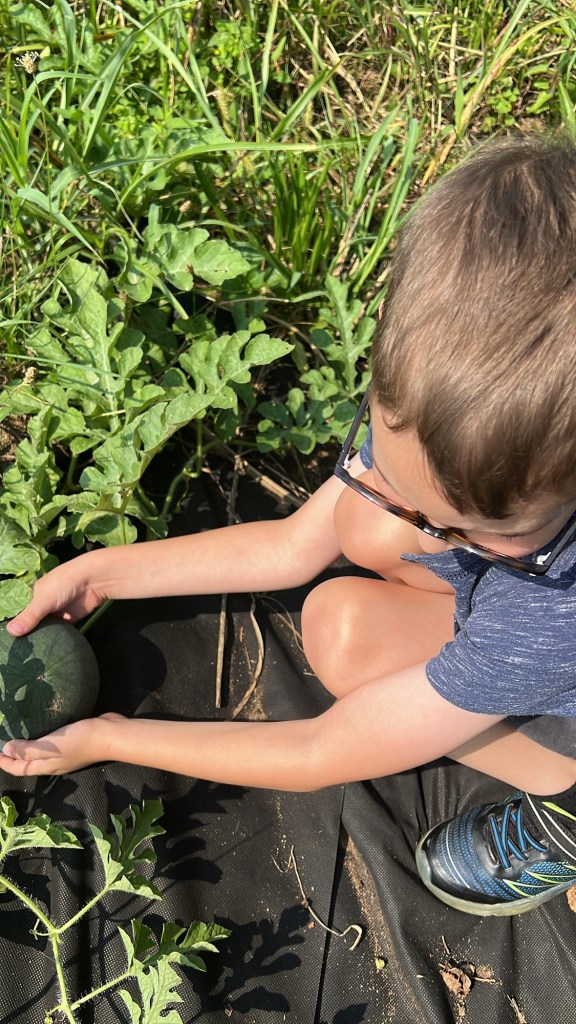
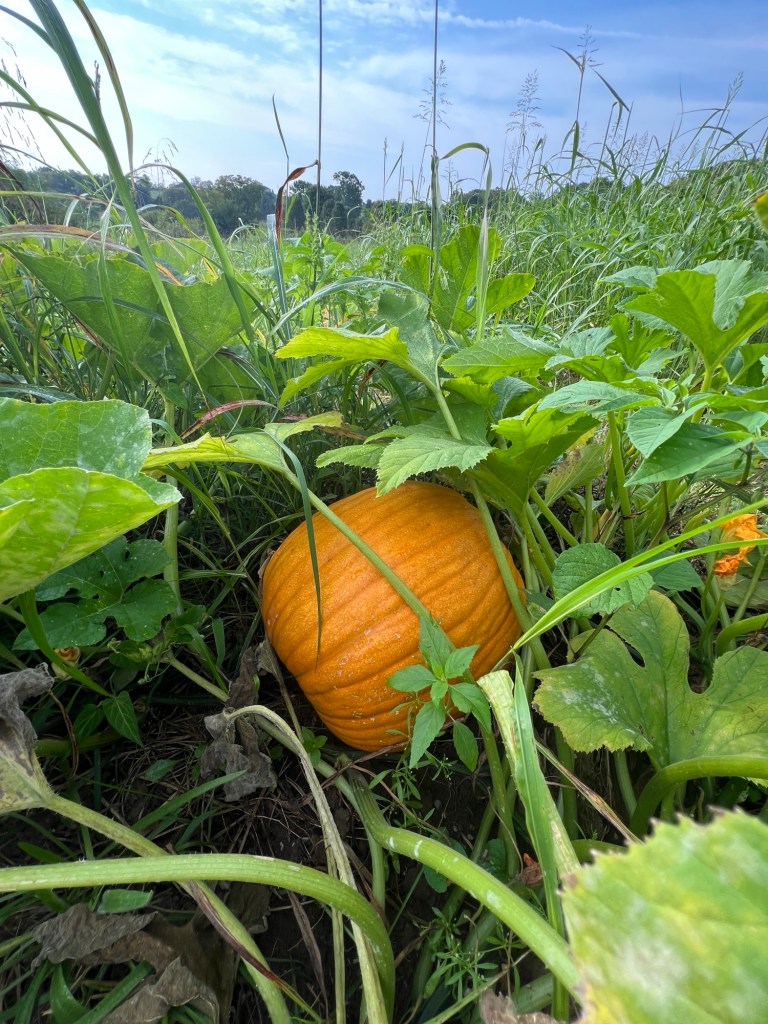
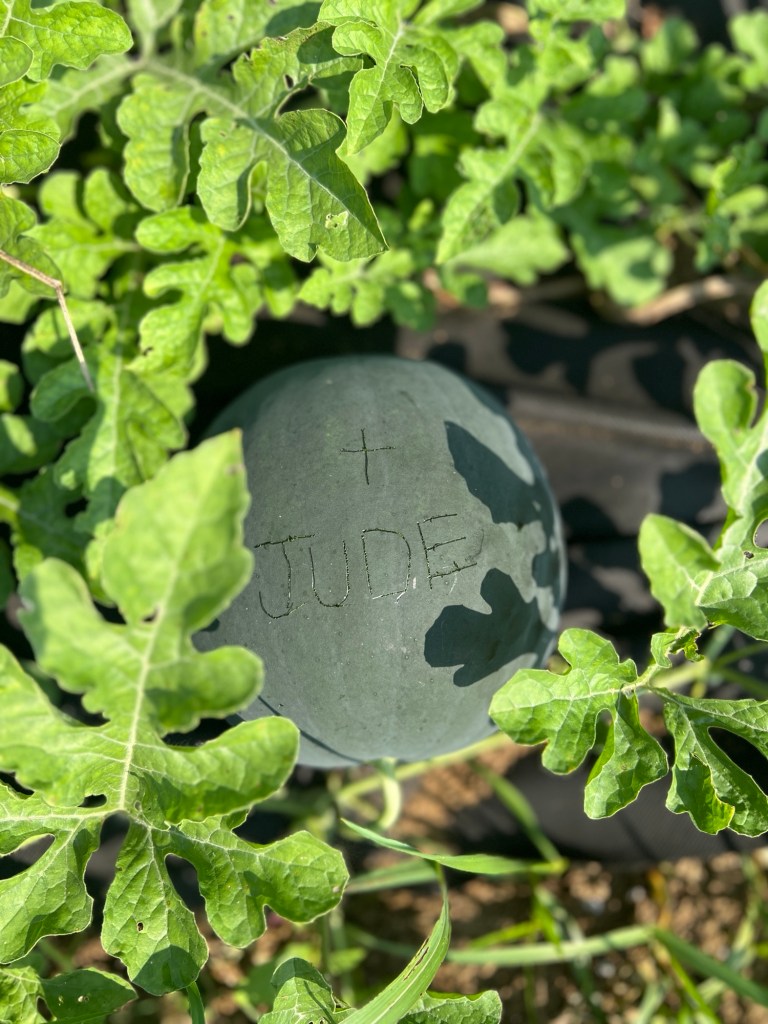
But, eventually, and through many hours of Hule’s tending and weeding and laying out landscape cloth, the okra emerged in a nice straight line. Little baby watermelons came out—some too cute not to be picked and pocketed by our grandson. Even pumpkins grew! That has been fun watching the pumpkin vines stretch out into the pasture as they make more and more small orange globes.
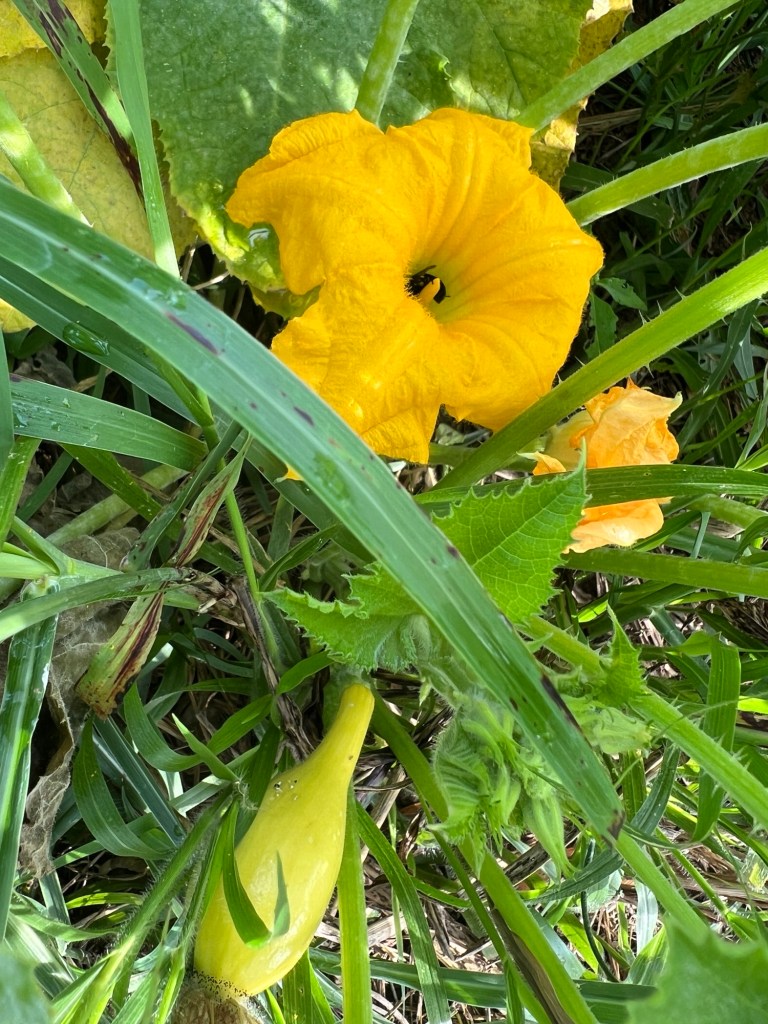
But, by far the star of the show has been our summer squash. Unbeknownst to us, all 3 of the planters had taken on the task of planting hills of squash. So—we have been inundated with it. I’ve made fried squash, boiled squash, stir fry squash, and squash casserole. We’ve brought bags of squash to our daughter in Lexington and to our neighbor. And, for those “big’uns” (as my grandparents might have said) we created a new compost pile—a pile of crooked neck gold out in the field that, we hope, will eventually become soil again. Some of the squash went to our 3 chickens, but they are particular and slow to eat it. If there is any hope of fruit or worms, they turn their beaks up and snub the squash.
Whenever I watch this miraculous unfolding of vine and leaf and fruit from seed, sun, soil, and water, I am taken aback. When the small green striped orb in my grandson’s hand becomes as big as his torso in just a few short weeks, and develops into something enough to satisfy several families at a picnic, I am in awe. When I look at the gorgeous yellow and purple blossoms on the okra stalks morph into green edible pods and the gigantic orange squash blossoms birth cute baby yellow vegetables overnight, I am mesmerized.
The garden becomes a sanctuary.
It all reminds me of a quote—one of my favorites—from Wendell Berry from The Art of the Commonplace: The Agrarian Essays:
“…outdoors we are confronted everywhere with wonders; we see that the miraculous is not extraordinary but the common mode of existence. It is our daily bread. Whoever really has considered the lilies of the field or the birds of the air and pondered the improbability of their existence in this warm world within the cold and empty stellar distances will hardly balk at the turning of water into wine – which was, after all, a very small miracle. We forget the greater and still continuing miracle by which water (with soil and sunlight) is turned into grapes.”
I traveled to our Southern Illinois family farm to observe the April 8, 2024, eclipse. In 2017, I saw 1 minute 28 seconds of totality on this same Illinois farm, but I didn’t know at the time that I could look at totality without my eclipse glasses—so in 2017 I only saw what most of the others outside of totality saw, other than the heightened darkness that came to the environment around me during totality and a complete disappearance of the sun through the dark protective film of my glasses.
This year I discovered that the real show, for me, is both watching totality without eclipse glasses—a true wonder in itself—and just as delightful, watching others, hearing others, simultaneously experiencing this heavenly splendor right next to me.
I watched my 5 year old grandson, Julian, dancing around in celebratory circles, pausing occasionally to put on his special glasses to announce the phases of the disappearing sun: “I can see the moon.” ” It’s just a fingernail!” “It’s a sliver!” “The bees are going back to their beehive.” And during totality, “I can see two stars.” “I actually can see a red “o” on the moon,” he declared when a solar prominence, a burst of plasma, became visible from the bottom of the sun’s corona.
My son-in-law observed, “You can feel it getting dark. Oh gosh, it’s happening.” Then seconds later he exclaimed, “Oh, there it is! There it is, you can see it! Oh, my gosh!” with a similar enthusiasm and excitement as he had when I stood next to him nearly 8 years earlier at the birth of his first child.
My daughter, currently working on her Ph.D. in astronomy and physics, watched in her quiet—the same quiet I saw when she herself was born—a silent, peaceful, pensive observation. Afterwards she imagined the experience of traveling along the path of totality to observe it longer.
My husband, Hule, was instructing the grands when to use their glasses and when they could take them off. He responded to the cooling atmosphere by putting on a sweatshirt and commented on the stars and birds. He tried to help Julian and Hazel appreciate the beauty of the occasion and know its significance.
My 87-year-old mother was observing totality for the first time. She reminisced about how in grade school they had made a pinhole projector to observe an eclipse. She commented on the streetlight coming on. And when totality came, she said: “I can’t see it in my glasses…I’m not going to be able to see anything. I’m afraid to take my glasses off.” Then, “Oh. Oh my gosh! It’s spectacular! Are you sure it’s ok? Oh…That’s the brightest diamond I’ve ever seen.” “It is fabulous.” “Oh, I wish we could get a picture of that, it’s so beautiful.”
Photo Credit: Rick Fienberg
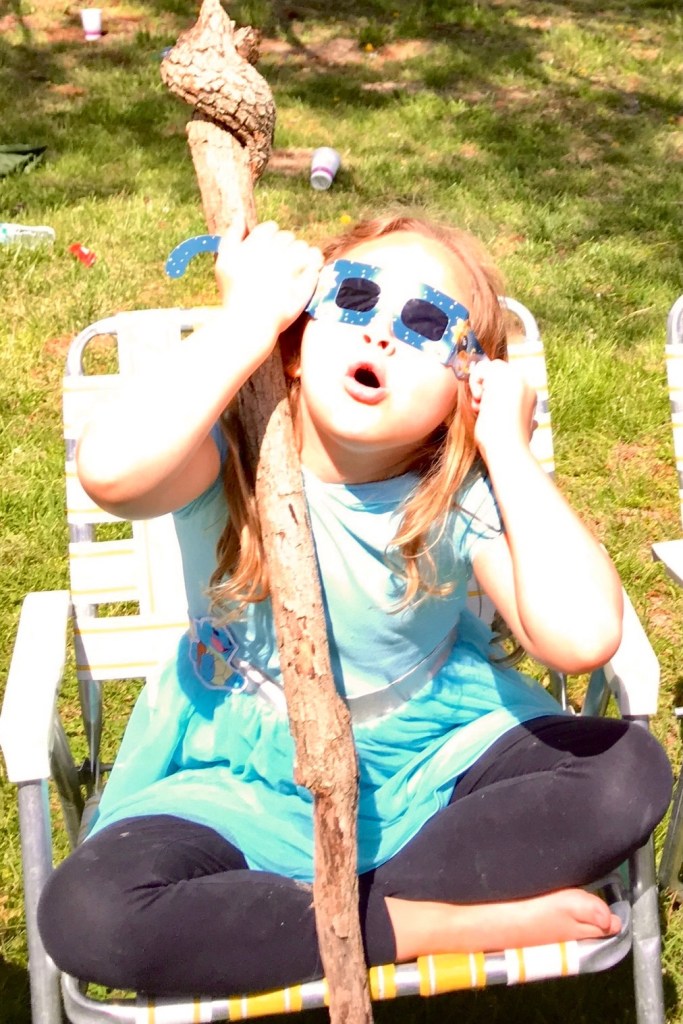
My always animated granddaughter Hazel was the most memorable for me to observe. Just before totality she said, “It’s so dark! It’s literally the smallest sliver!” “Woe!” “Something is happening to the ground! I see the stars. It’s happening, and it’s so dark!” And once totality arrived, she declared, “It’s amazing. It’s making me feel so weird. I feel cold, but I know I’m not. Why is it sunset on all sides? That is amazing, I’ve never seen anything like that!” And about 2 minutes in, Hazel requested, “Everyone be quiet, I want to see if I can listen.”
(…And a little child shall lead them…) …
Hazel in awe
Then, the light came rushing back with a streak.
We were all changed in 4 minutes and 7.5 seconds.
Hazel’s amazement and celebration continued. “Wow, I’ve never seen that…” breathing deeply, nearly panting. (“Except in a book,” Jude added.) Hazel bent at the knees then stood straight up, head to the heavens, eyes closed, and she laughed and laughed. Papa Hule came over and stroked her head. She squealed in delight. “I’m sooo happy!” Twirling around and around she repeated, “That’s the first time I’ve ever seen totality in my life, and I’m 7!”
The way I remember what people said and how they looked, is that I had 4 cameras going. One iPhone was on a tripod with a solar filter, watching the sun, but “listening in” on conversations. Another, iPhone was propped up across the way, observing the observers. I held one iPad on my lap with a solar lens attached and had another “naked” iPhone in my hand. I could not otherwise have taken it all in and remembered it as accurately.
For me the eclipse was impressionistic, poetic:
Diminution of the sun—one bite at a time.
Twilight twice in one half hour period,
And the sudden darkness,
Expected, but only known when experienced.
Then,
A Communal gasp of Awe.
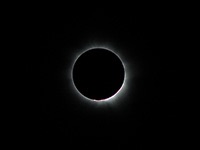
A narrow Ring of bright cool light dancing around a perfect dark disc.
The large bright creation that keeps us alive and feeling “safe” on earth is covered up by our nightlight.
Our heat and light,
Our stove and lamp,
Is overshadowed by
Our nighttime companion,.
It becomes one with its companion.
There is a union of them with one another,
And them with us.
Creatures around us are bewildered and we think of our early ancestors who were taken aback, astonished, surprised, when dark descended during full day and when “Brother Sun and Sister Moon” fused.
Light is foundational to our existence. We are drawn to the light of the stars. We bask in sunshine, observe sunsets and sunrises. These mark our days. Despite years of discoveries, so many mysteries remain concerning light.
Jesus called Himself the Light of the world. He instructed us not to allow our light to be hidden. He tells us to let our light shine.
Photo I took during 2024 eclipse
God has hidden shadows, metaphors, similes, everywhere, since the beginning of time. What is the meaning here?
With light comes dark. When Light departs, dark descends. Darkness covered the earth during the day when Christ died: from noon until 3 o’clock.
My daughter, Julianne, an astrophysicist, must include “dark matter” in her mathematical equations to simulate theoretical galaxy formations.
God, is there a meaning here in this eclipse? You drew an X over the U.S. with the last two eclipses observable to us. Our Illinois farm was in the center of the X. But, like contrails above, You are forever drawing signs in the sky. To focus on this one, these two, is it egocentric? It is so special to us because we in the U.S. get to see it—it has come to us. Thank you!
Photo I took while retreating at Abbey of Gethsemani in KY
St. Augustine said of God’s ways: “We are speaking of God; what marvel, if you do not understand? For if you understand, it is not God.”
“Total solar eclipses typically happen every one to three years somewhere around the globe, but the events are often only visible from Earth’s poles or from the middle of the ocean.” (CBSNews.com)
So, maybe it is a reminder that we are not in charge of light and not in control of moon and sun. Maybe it is a way to remember our sameness and lay aside our differences while we gaze at the wonder of it all.
And though the sun and moon are important, light was brought forth on the first day, before the sun, moon and stars appeared on the fourth. (Gen. 1:14-18) These latter lights were said to bring time—day and night, and for signs and seasons. One to govern the night and one the day, and to separate light from darkness.
But as glorious as it is to observe the lights above, it seems that they are not necessary to eternity. In the mystery of the Word we get a glimpse of something even brighter and more spectacular—worthy of our Communal Gasp of Awe:
“Then I saw ‘a new heaven and a new earth,’ for the first heaven and the first earth had passed away…The city does not need the sun or the moon to shine on it, for the glory of God gives it light, and the Lamb is its lamp. The nations will walk by its light, and the kings of the earth will bring their splendor into it. On no day will its gates ever be shut, for there will be no night there.” Revelation 21: 1, 23-25, NIV
I find myself praying today for a friend’s imminent childbirth. Giving birth is such a thin place, where we join in creation and fall simultaneously. It’s a miraculous space: liminal—in-between. The father, mother, and child, pass through a limen—a doorway—from unknown to known and from known to unknown. There is a change in “I am-ness” to each participant—even for every sibling and every grandparent.
When my first grandchild was born, I stood at the head of the bed and experienced the miracle unfolding. I saw my dear daughter rock in pain with contractions and reach in joy for her new writhing, crying, little human-gift. I observed the furrowed brow, outstretched hand, and deep concern of my son-in-law at bedside; then the outrageous excitement of seeing the emergence from dark to light of his firstborn, Hazel—with a holy hush followed by one last push.
When my second grandchild, Julian, was born, I stayed at home with Hazel. It was a different kind of vigil—from far away. It was hard not being present and I was grateful to God and His sure presence with me and with my daughter simultaneously, and His constant bent-ear, listening for our intercessions and supplications. I wrestled with the thought that my daughter would need to struggle with pain, maybe blood, and difficulty for this birth, and I recalled the reason that the Bible gives to aid in answering all, no, most, of my questions.
The night before Julian’s entrance, I birthed the following thoughts. I pray they might help you or your loved one in grappling with, and entering past the veil into, this angel-filled, Trinity-immersed, Cloud of unknowing which we encounter at the emergence of every new life…if we have eyes to see.
Julian’s Exodus
And now
As we turn toward this event
This liminal passage—
A new life liminal passage—
We remember that You Lord, are a Parent
A Father and “Mother” to a boy, Adam and girl, Eve
Formed long ago in the womb of your garden,
“born” into your household.
And even before that
(really not before, but always)
Your only Son—begotten, not made—of one Being with You.
But there came a fall—
Jack and Jill tumbled
And pain in childbirth came,
Not the original plan,
But a consequence.
So now we embark on a new in-between space
One that, despite our knowledge and advancements, will likely bring some
Pain
Squeezing
Peril
Need
Perhaps groaning.
“Like the pains of childbirth,” we often say:
A groaning of earth in an Eve-like form.
We come here through remembering also that you overshadowed blessed Mary—
Dripping in Eve-ness—
To bring hope and healing
To bring back full joy and to ease the pain of Eden’s losses.
You sent shepherds and wise men for the baby shower.
You watched as the wet, crying and cooing boy emerged from the nine-month hiddenness.
You sent angels to say,
“Do not be afraid!”
You said, “My peace I give to you.”
And, “I will never leave you or forsake you.”
And so we pray to You—
Who are a Father
And a Son
And have a maternal heart
And are a great Physician
And a Summoner of angels.
We look to You
To bring the Light –Da la Luz!
Of Your presence
Your face
Your touch
Your attention.
We ask for safety for all during labor and journey through the underwater tangles, the unknown, the Red Sea’s partings, little Julian’s exodus into this world.
We look to You.
We trust in Your great love,
In Your deep knowing—conocimiento—that is owned by a Parent’s heart and soul and body.
In Your Son Jesus’, name,
Amen
[i] Jesus is the bridegroom and the church is His bride.
[ii] Many places in the Bible God is portrayed as having motherly affection and care:
God: “As a mother comforts her child, so I will comfort you; you shall be comforted in Jerusalem.” Is. 66:13
God: “Can a woman forget her nursing child, or show no compassion for the child of her womb? Even these may forget, yet I will not forget you.” Is. 49:15
God: “For a long time I have held my peace, I have kept myself still and restrained myself, now I will cry out like a woman in labor, I will gasp and pant.” Is. 42:14
Jesus said, “How often have I desired to gather your children together as a hen gathers her brood under her wings, and you were not willing.” Matt. 23:37 and Luke 13:34
“I see it, I see it,” said Hazel, pointing to my small paisley decorated retractable tape measure.
“What do you see?” I asked.
“The virus. I see the virus!”
For over a year now our lives have been rerouted and turned upside down because of “the virus”. Hazel has often referred to “the sickness”. Hazel is four and, despite being her grandma, I declare she is nigh a genius. 🙂 Her mind is continually picking up things said, things seen, things smelled, and integrating them quickly into her vast repertoire of knowledge, then easily figuring out a way to express those new discoveries. So, like a true nurse educator and science lover, I said,
“Oh, nobody can see the virus except with a very powerful microscope. But Hazel, here… (I pulled up the image on my phone), this is the coronavirus. See, they made a picture of what it looks like under a microscope.”
PHIL.cdc.gov
Even Julian, my curious two year old grandson, came near to see it too. They both studied it.
Hazel paused for a while…..
“But, is it real?” she asked.
“Well, this is a picture of it, but this is not the actual virus here in my hands.” I said.
“What?” answered Hazel.
“Well–like when I have a picture of you–see?” I showed her a picture of herself on my phone. “That is a picture of you. You are real, but that is not you. You are real, but that is just a picture of you.”
At this point I was even getting confused. We started taking pictures of things with the iPhone and then showing the real thing next to the picture of the real thing, but she kept saying,
“I don’t know what you’re talking about.”
This was the first time I had encountered Hazel being stumped and it surprised me.
But it got me thinking. Thinking about this world she’s raised in. Watching TV, animation and news come into the living room back to back. Every Christmas and Easter we walk the tightrope of whether Santa or the Easter Bunny are real. Then there’s God and Jesus. We read Bible stories and then Paw Patrol stories, Anatomy books and books of fairies, then of angels. We go to church and say grace at meals and even whisper prayers in the air from time to time:
“Is there really a Chase and Rubble? Is that really what my body looks like inside? Are angels real? Are fairies? Is God really real? Is Jesus God?
What is real?
And, how do you explain that to a four year old. And how do we even know that ourselves?
Because of art and books and movies and TV, and video games, anyone’s imagination can become visible. So, anything and everything seems real when brought to the vision and hearing–especially to that of a child. Is this touching on why Jesus said:
“Let the little children come to me, and do not hinder them, for the kingdom of God belongs to such as these. Truly I tell you, anyone who will not receive the kingdom of God like a little child will never enter it.”
Children are sponges and readily receive the reality of the kingdom of God. Even great thinkers like C.S. Lewis and G.K. Chesterton entered kingdom realities through the portals/wardrobes of childhood’s believing. To my logical mind, this seems reckless. Hazel has imaginary friends and talks to them. Who knows, but that to her, our prayers seem like talking to imaginary friends. We have “pictures” of Jesus, but we explain that’s not really a photograph or even painting of the real Jesus–nor is the picture the actual Jesus himself. And then there comes the explaining that not all people even believe that God is real. And not all people believe Jesus is God. He wants us to come to him in faith. Our belief in him is what takes us to the doorknob to open the door and “see him”.
But this is not just a God conundrum. There are some who do not believe there is a coronavirus and they live as though there isn’t. There are consequences to that action; but the virus doesn’t exist or not exist, infect or not infect, its substance and reality do not change, based on whether we believe strongly enough in it. It just is what it is.
Hazel and Julian in the time of “the virus”
The God of the Old Testament introduced himself as, “I Am Who I Am.”
The substance, the reality of God, does not rely on our belief, but our faith in him opens or shuts the door to our friendship with him. Jesus asked, “Who do people say I am?” and “Who do the crowds say I am?” Then Jesus asks the REAL question: “But what about you? … Who do you say I am?”
Jesus introduced himself as I Am:
“I am the bread of life.”
“I am the light of the world.”
“I am the door.”
“I am the good shepherd.”
“I am the vine, you are the branches.”
“I am the way, the truth, and the life. No one comes to the Father except through me.”
“I am the resurrection and the life. He who believes in me, though he may die, he shall live. And whoever lives and believes in me shall never die. Do you believe this?” he asked.
Do you believe this? Is God real? … even if we don’t have a microscopic close up photo of him? Are you living like God is real? Today Jesus asks each one of us what he asked his disciple:
“But what about you? Who do you say I am?”
Scriptures referenced above include Exodus 3:14, Mark 8:27, Luke 9:18, Matthew 16:15, Mark 8:29, Luke 9:20, John 6:35, John 8:12, John 10:9, John 10:11, John 11:25, 26, John 14:6, John 15:5











 Our Jessamine Farm