Shorty’s Chair

“Only take care, and keep your soul diligently, lest you forget the things that your eyes have seen, and lest they depart from your heart all the days of your life. Make them known to your children and your children’s children.” Deuteronomy 4:9 ESV

It will soon be Thanksgiving and many of us will gather in homes across the country, making way for hospitality, for extras to feast with us, telling stories of the past, reminiscing, taking time to thank the Lord for family, food, and all life’s blessings past, present and future. To celebrate, we use all available chairs around our dining tables—even the less comfortable ones. I have a story about one such chair at our house.

There are a few things that tether our Jessamine County Kentucky farm with my Plasters family’s farm lying 278 miles westward near Cave Township in Franklin County, Illinois. One fact I just discovered as I researched this writing is that both farms are in the 37th Parallel North, which is referred to by some as “The Paranormal Highway.”

But the connector that prompted this telling is one that has traversed the path eastward from Illinois to Kentucky. We call it “Shorty’s Chair.” It is a plain small ladderback wooden chair with a woven seat. There is a mysterious dip in the top slat of the chair. Dad told me it is where his uncle Shorty would sit in the chair backwards, one leg on each side straddling the seat, in front of the potbellied wood stove in the old Illinois farmhouse, as Shorty’s chin (or mouth?) created that hollow top of the chair. (I have sat on it to test the theory, and it is possible.)
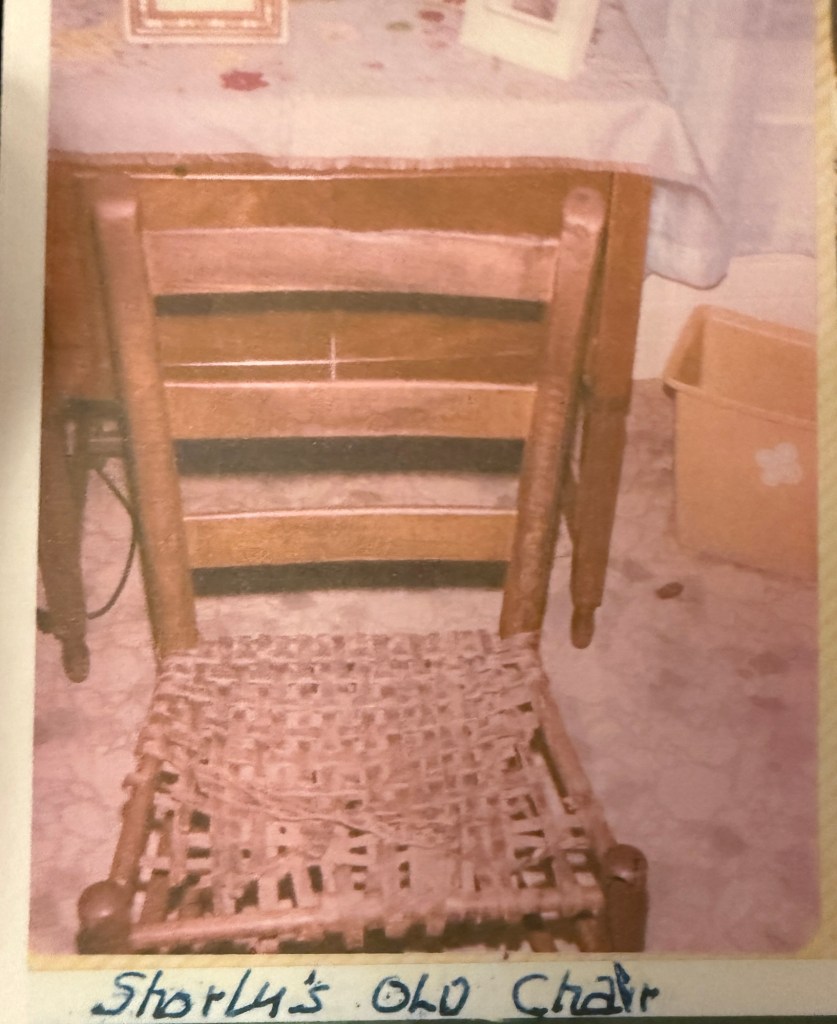
 

Shorty’s old chair in the Illinois farmhouse

Shorty was a lifelong bachelor and World War 1 veteran. His real name was Elmus Plasters and he cared for his mother, Malissia, my great grandmother, until her death in 1963.
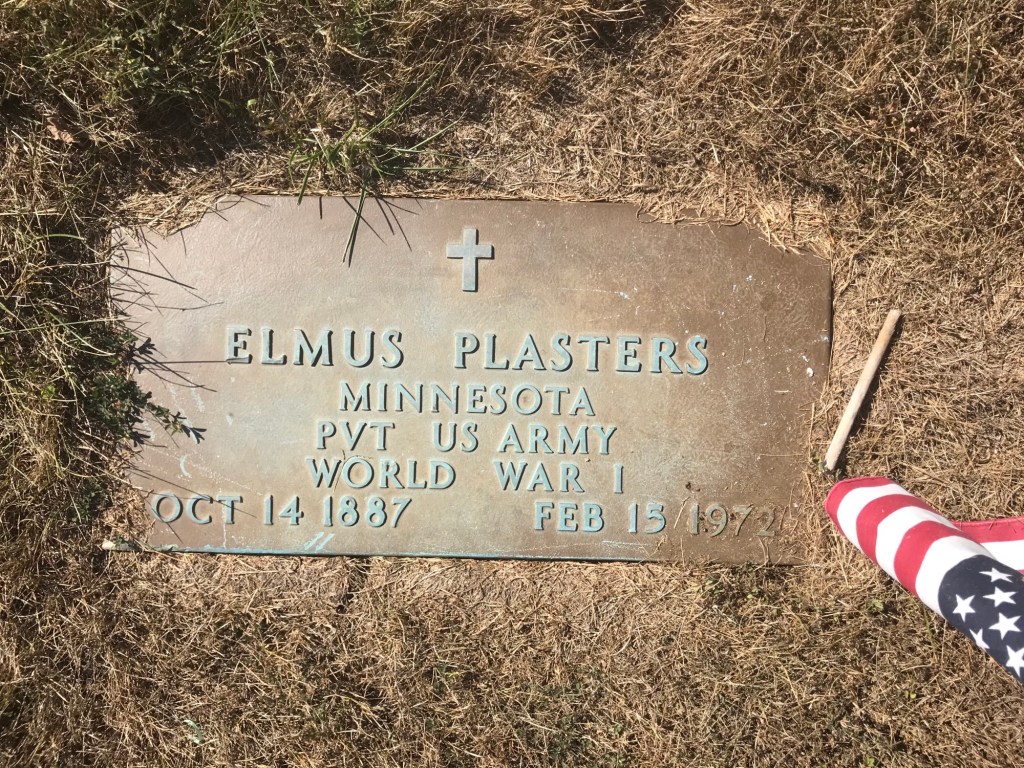
Shorty’s military marker

Her tombstone says she was born in 1864 and died in 1963. We have a newspaper clipping celebrating her 100th birthday…maybe our family gets our dates mixed up sometimes :)?
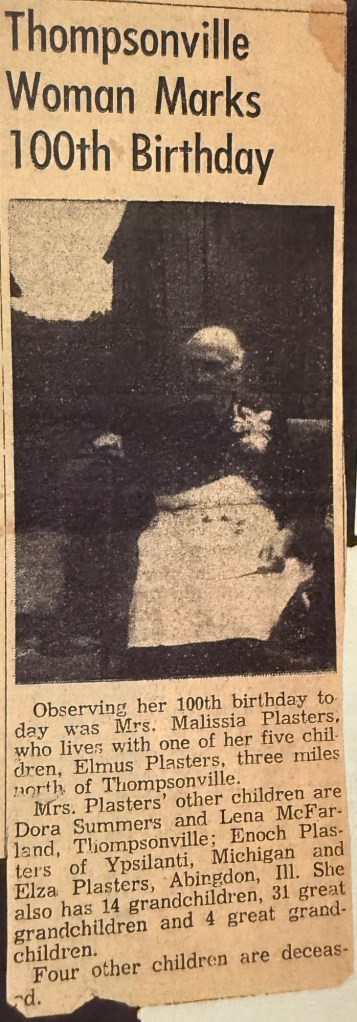
The only encounter I remember with Malissia was my first recollected introduction to the Illinois farmstead. As I look at the dates, I would have only been about 3 ½ years old, but it etched a memory in me that is still present; likely because I was a bit terrified. My Dad and I entered through one of the two front doors from the front porch. The house was old and smelled strange to me. Uncle Shorty was sitting by the fire and there was a bed over in the corner of the room. On it was a lady under a lump of covers. I could discern no face, but I heard her turning back and forth. She was moaning. Dad told me later that he remembered that his grandma would moan in pain and Shorty would have to say, “Ma, we don’t have money to buy any more aspirin.” I recall the hand and presence of my father as the only discernably familiar spot in that home. I was as equally troubled by the presence of a bed in a living room as I was with the faceless moaning woman in the corner. And Shorty was strange too. From his small chair his face was nearer to my face as any grownup man that I remembered meeting. Also, his southern, nasal country talk was alien to my little toddler ears.
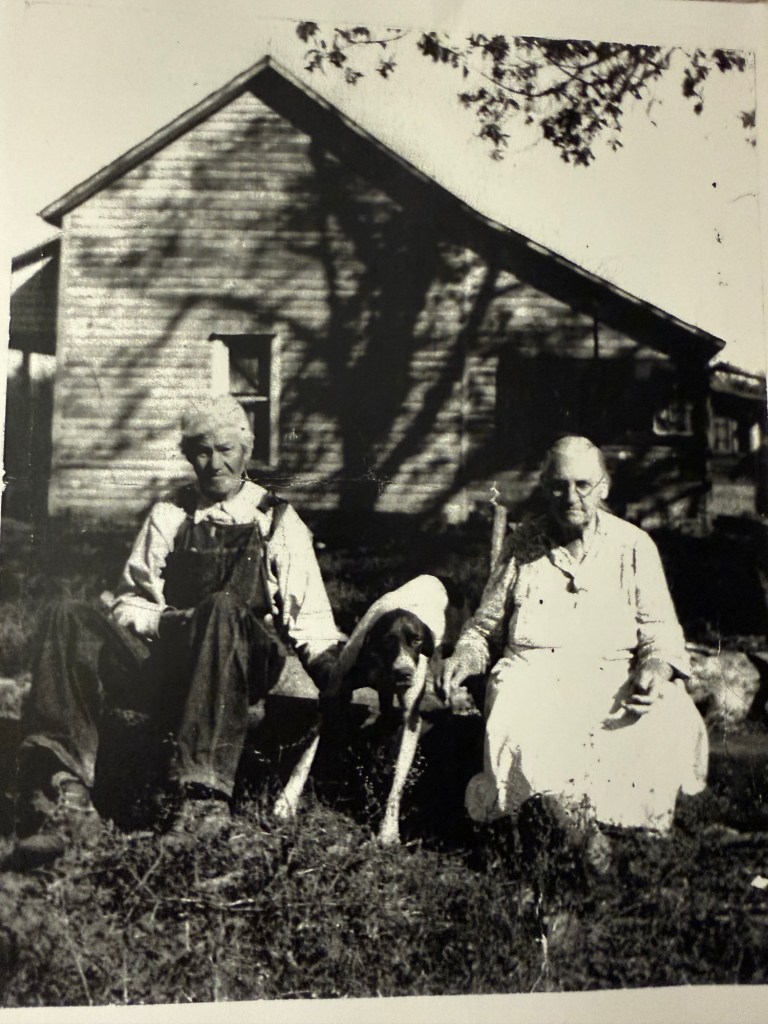
Malissia and Robert with their dog Nell in the side yard of the old Illinois farmhouse, likely one of them is sitting in “Shorty’s” chair

I must have said I was thirsty and I was escorted into the kitchen where there was a metal pan sitting on a wooden stool with a carved-out gourd on it. That was the “common gourd.” Everyone sipped from it like the common chalice in an Anglican communion line. I learned later that they had dipped that water from a well out back. Indeed, as I look back, it seemed like a 37th Parallel Highway moment.

Shorty lived on in the family farmhouse until the early 1970’s. When Uncle Shorty got sick and had to go to a hospital my dad arranged to buy the family farm as a summer place for us; part of the money was to help pay for Shorty’s hospital bills. Dad’s memories were there and, in the house just around the corner, and one down the street. Uncles and aunts had dotted that small area of land for years. The earliest ancestor, John Plasters, obtained the acreage in the 1850’s as payment for his service in the military. The subsequent family line had farmed the acreage until our purchase of it.
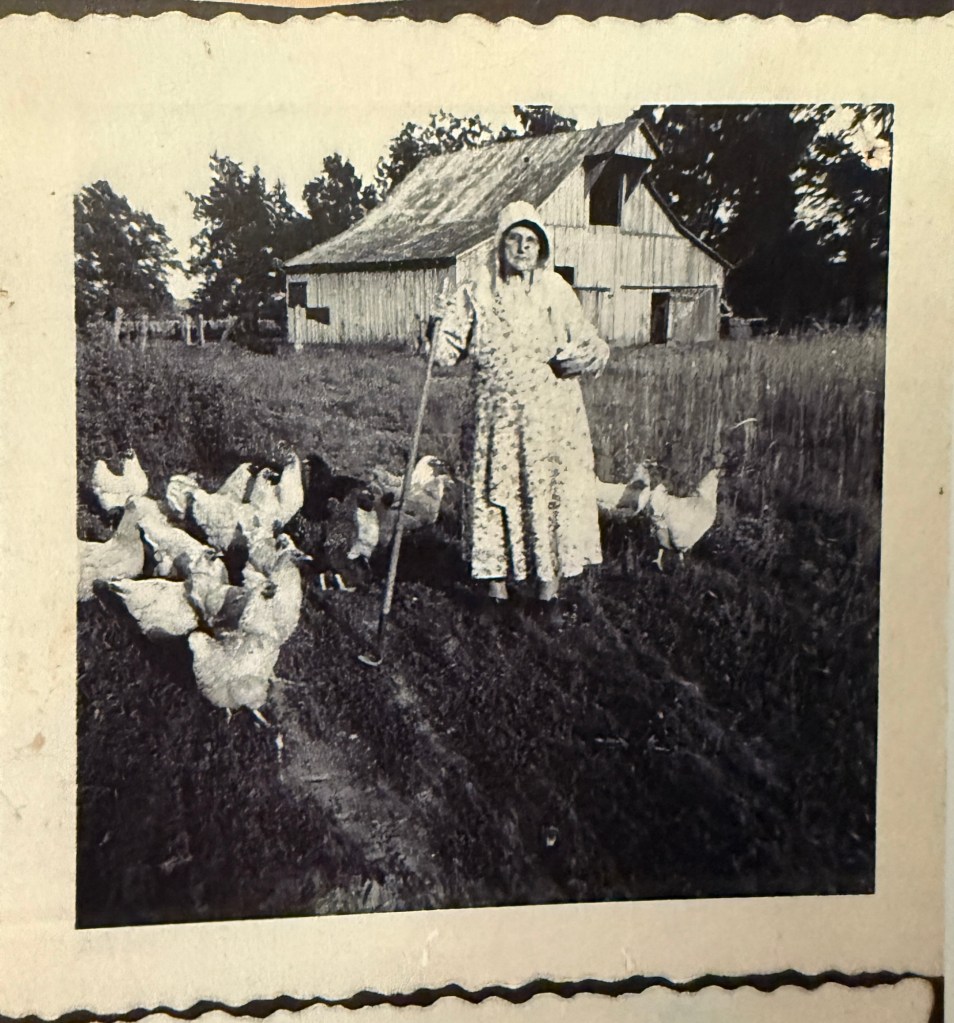
Great Grandma Malissia with her chickens at the Illinois farm

When we got the farmhouse Mom and Dad worked hard to give it a semblance of new life, but a few artifacts remained—one of them was Shorty’s chair. We summered and weekended there as a family. That chair was witness to my teenage vacations and to Christmas Eve 1977 when I brought my Mississippi boyfriend, Hule, there and he got down on his knees and proposed to me. It also stood sentry in the living room when we returned six months later to spend a portion of our honeymoon.
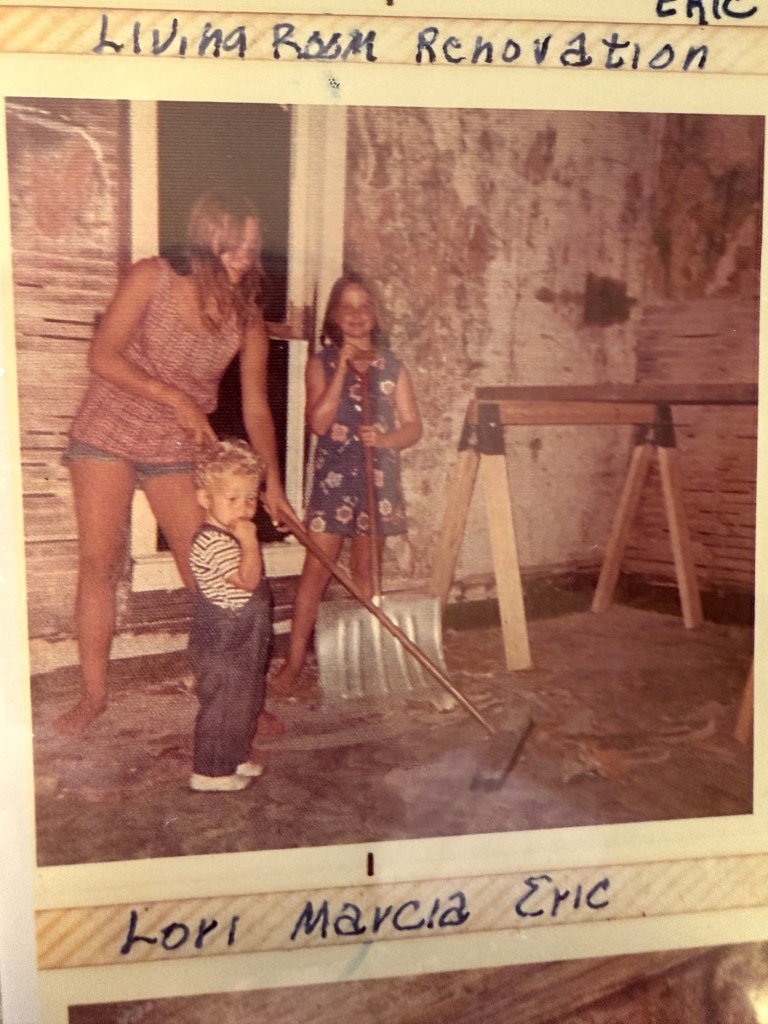
Renovating the Illinois farmhouse living room: Me (“Lori”) with my younger sister Marcia and little brother Eric. The corner you see is where Great Grandma Malissia’s bed was.

There came a time when that house disintegrated enough that it had to be torn down. We still have the farm, and a different house stands where it stood. My dad salvaged Shorty’s chair as one of his precious heirlooms. He brought it up to our Springfield, IL home. Dad’s dream was to live full-time in a small Thoreauesque cabin at the farm with only a fire, a chair, and one hook for his clothing. Shorty’s chair represented that never-realized dream.
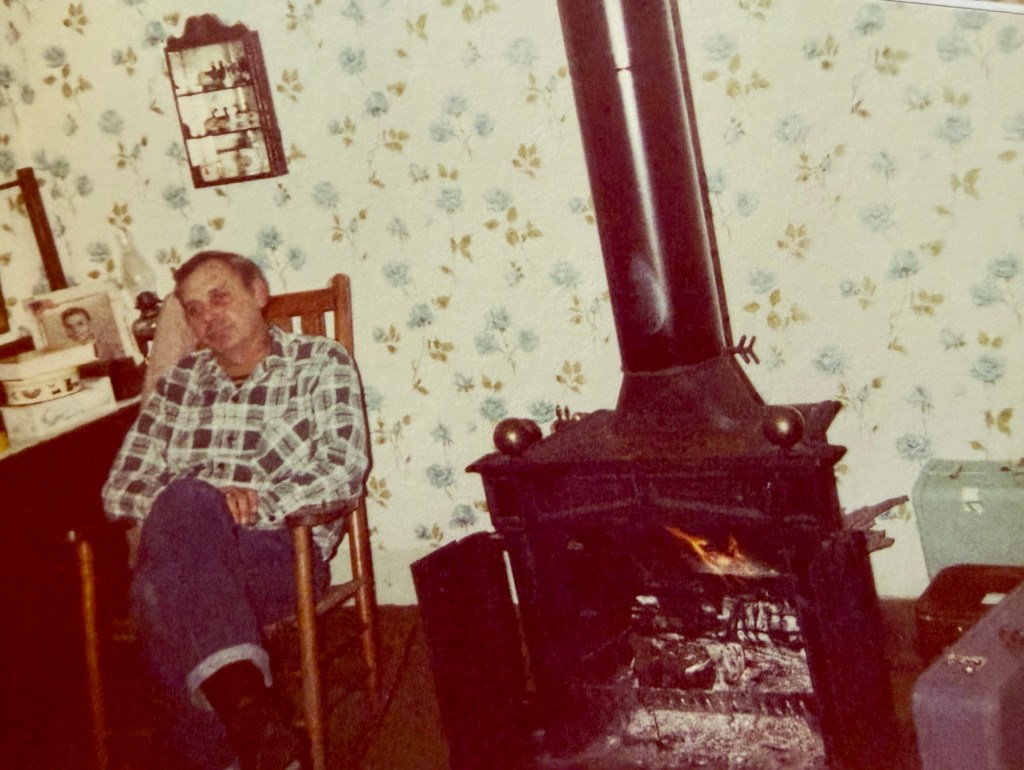
My dad relaxing by the wood-stove in the Illinois farmhouse living room after the remodel

For Dad’s gift one year Mom arranged for the seat of Shorty’s chair to be re-woven because it was quite worn. Some years later, as my mom didn’t have much room for it in her house, she gifted it to me. It now sits in the modest home of our Jessamine farm. It is used mostly when extra guests come and we run out of the upholstered, more comfortable seating. But it sits there as an icon—full of symbol and meaning and memory, linking our past to our present and future on this rural landscape situated in the shared 37th Parallel North.
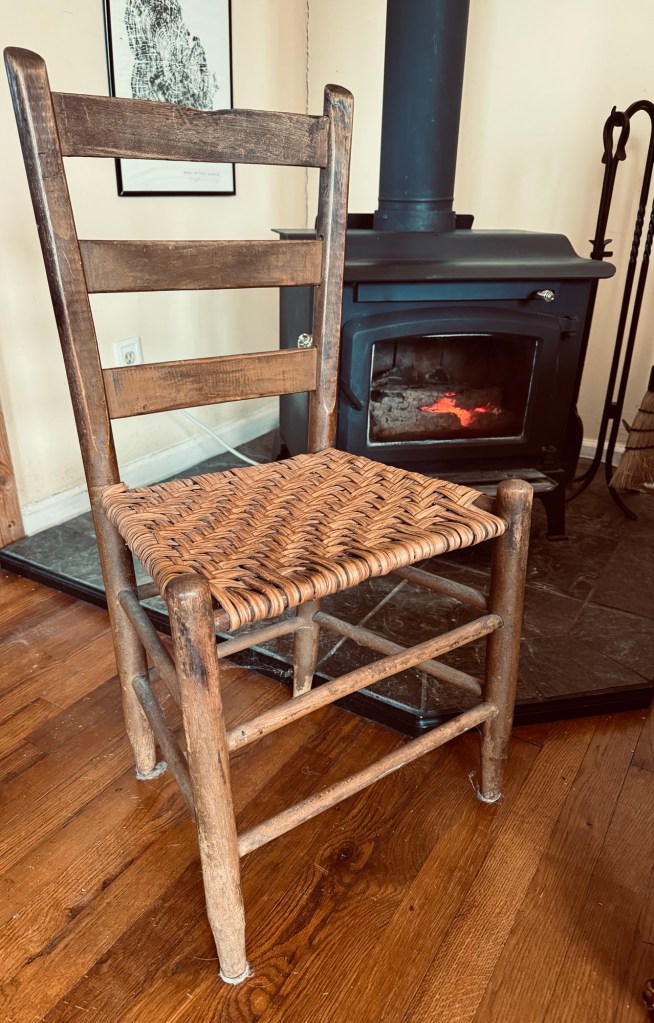
Shorty’s chair in our Kentucky farm living room by our wood-stove

+++++++++++++++++++++++++++++++++++++++

“I remember the days of old; I meditate on all that you have done; I ponder the work of your hands.” Psalm 143:5 ESV
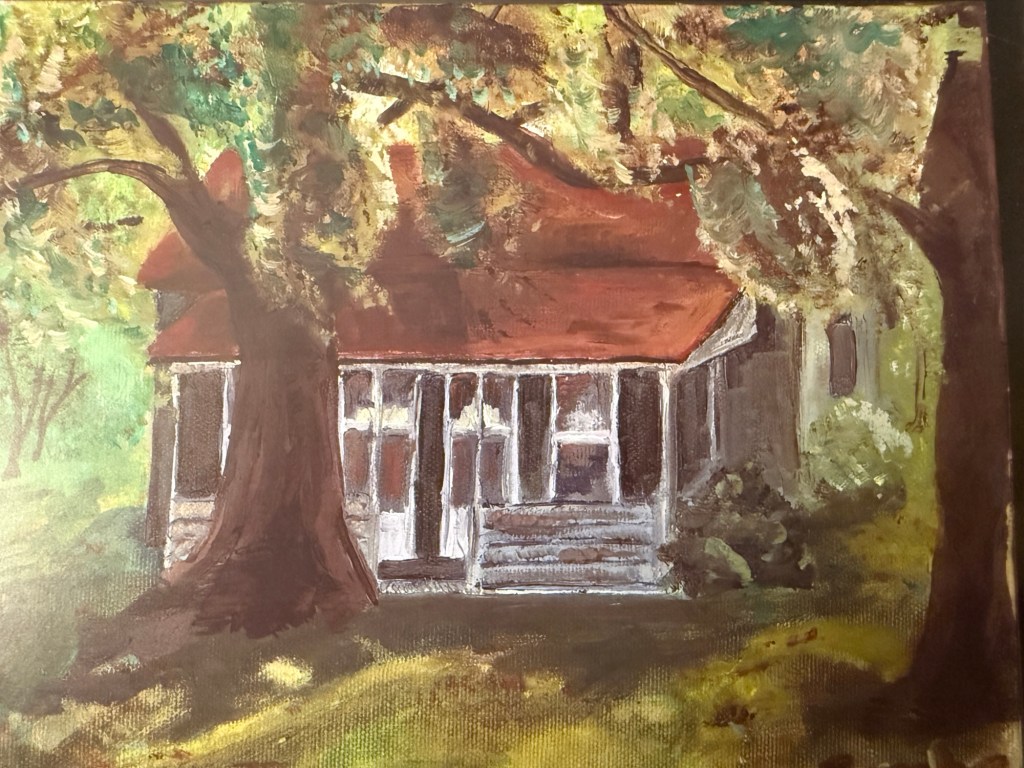
 

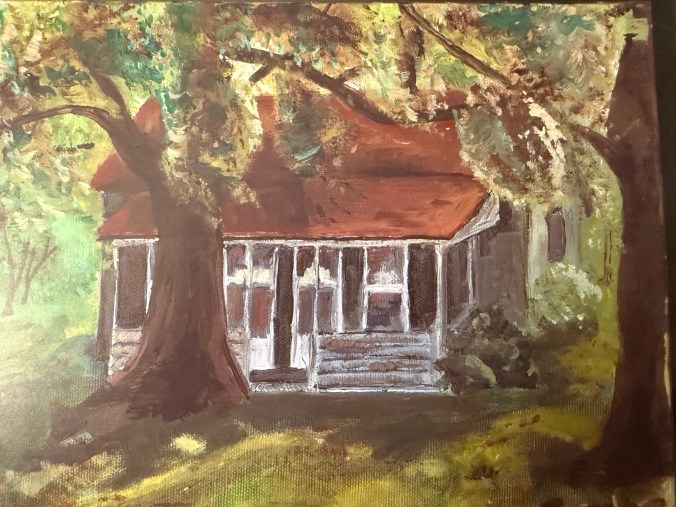
The old Illinois farmhouse painted by my daughter Sarah Jo Goddard

Family Photos

The Goddard Easter photo of 2024

For us, Easter is the perfect time to take a yearly family photograph. We are already “dressed up” for church and often a beautiful backdrop of spring flowers, a canopy of birds, warm sun, cool breeze, and freshly mown lawn sit ready in the front yard for the occasion.

I am currently the volunteer photographer in our family. There is one of us in every group; someone with determination and conviction strong enough to weather protests, moans, and eye rolls of many a reluctant participant. Whether invited or dreaded, we familial paparazzi emerge as mini dictators for a few short minutes during the photo shoot and then slink back into place after the negotiations and battles have settled.

This is the quintessential “line up” type of picture. I discovered early in the process that I had to capture just the right moment to stage the photo. It is best for us after church but before the noon meal. That way we are not yet dotted with drips of veggie casserole and honey ham juices, and we haven’t put on stretch pants necessary to accommodate bulging waistlines. The kids will later start begging to go look for eggs in the yard and to eat the ears off their giant hollow chocolate bunnies.

I call this photo op “seizing the day” or “carpe diem” as the Roman poet Horace put it. Who knows what’s ahead and how many other celebrations we will have all together.  After this year someone’s image might drop out, temporarily or permanently. Children grow up. Marriages break up. Some move away. Others pass on. There will never be another today.

We have hundreds of similar photos of ourselves or relatives from generations past, and I treasure them. What people wear, their expressions, interactions, who stands next to whom, the car, house, yard, tree, or pet in the background are all things captured at this unique point on our communal timeline.  There is a necessary moment of closeness required. Often touching, we gather like little chicks under a hen’s wing, uniting for one purpose, warming ourselves briefly near the fire of family.

Each picture tells a story. Sometimes there is an undercurrent, a back story, that can only be known to the participants. That is why every photo requires a photographer, a storyteller, a listener, and someone to pass on to the next generations what cannot be caught by the camera lens.


This is a photo of our family at Easter two years ago. In this one Andrew is absent. We all look happy. Julianne and Matt have moved back to Kentucky from Washington with their family for Julianne to complete her PhD in Physics. I, Grandma Loretta, and Papa Hule soak in the joy of our family reuniting. Hazel is glad to be the center of attention. Jude finds his happy place in Momma’s skirt. He is unwilling to give us his face today. Sarah, our artist daughter, is home from Oregon for a while, but without Andrew. Living in our cozy attic, she soaks in sister-time, auntie crafts, and long, safe, healing bluegrass walks out back in wildflower fields.

For the click of a camera, we put on smiles. The priceless capturing of time, space, place, and face has been plucked from a precise moment never to be re-lived. Our cheerful expressions tell a true story, but not the whole story. I have “carp-ed” the big fat diem with my iPhone and printer. Now, it is time for other family storytellers to do their part.

(*This writing was done in a writers’ workshop at The Berry Center in New Castle, KY, taught by Georgia Green Stamper, author of Small Acreages, New and Collected Essays. She is a terrific writer and teacher! Thank you Georgia and Berry Center!)


A Communal Gasp of Awe

Photo Credit: Rick Fienberg

I traveled to our Southern Illinois family farm to observe the April 8, 2024, eclipse.  In 2017, I saw 1 minute 28 seconds of totality on this same Illinois farm, but I didn’t know at the time that I could look at totality without my eclipse glasses—so in 2017 I only saw what most of the others outside of totality saw, other than the heightened darkness that came to the environment around me during totality and a complete disappearance of the sun through the dark protective film of my glasses.

This year I discovered that the real show, for me, is both watching totality without eclipse glasses—a true wonder in itself—and just as delightful, watching others, hearing others, simultaneously experiencing this heavenly splendor right next to me.

 I watched my 5 year old grandson, Julian, dancing around in celebratory circles, pausing occasionally to put on his special glasses to announce the phases of the disappearing sun: “I can see the moon.”  ” It’s just a fingernail!”  “It’s a sliver!” “The bees are going back to their beehive.”   And during totality, “I can see two stars.”   “I actually can see a red “o” on the moon,” he declared when a solar prominence, a burst of plasma, became visible from the bottom of the sun’s corona.

My son-in-law observed, “You can feel it getting dark.  Oh gosh, it’s happening.”  Then seconds later he exclaimed, “Oh, there it is!  There it is, you can see it! Oh, my gosh!” with a similar enthusiasm and excitement as he had when I stood next to him nearly 8 years earlier at the birth of his first child.

My daughter, currently working on her Ph.D. in astronomy and physics, watched in her quiet—the same quiet I saw when she herself was born—a silent, peaceful, pensive observation.  Afterwards she imagined the experience of traveling along the path of totality to observe it longer.

My husband, Hule, was instructing the grands when to use their glasses and when they could take them off.  He responded to the cooling atmosphere by putting on a sweatshirt and commented on the stars and birds.  He tried to help Julian and Hazel appreciate the beauty of the occasion and know its significance.

My 87-year-old mother was observing totality for the first time.  She reminisced about how in grade school they had made a pinhole projector to observe an eclipse.  She commented on the streetlight coming on.   And when totality came, she said: “I can’t see it in my glasses…I’m not going to be able to see anything. I’m afraid to take my glasses off.” Then, “Oh.  Oh my gosh!  It’s spectacular!  Are you sure it’s ok? Oh…That’s the brightest diamond I’ve ever seen.”  “It is fabulous.”  “Oh, I wish we could get a picture of that, it’s so beautiful.”

Photo Credit: Rick Fienberg

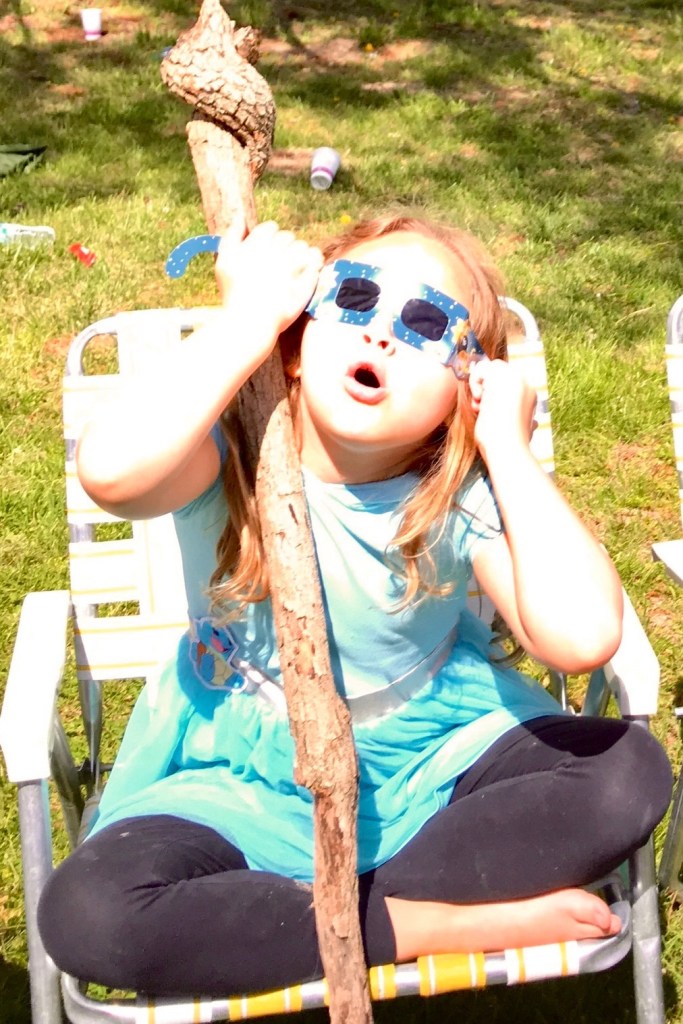
My always animated granddaughter Hazel was the most memorable for me to observe.  Just before totality she said, “It’s so dark! It’s literally the smallest sliver!”  “Woe!”  “Something is happening to the ground!  I see the stars.  It’s happening, and it’s so dark!” And once totality arrived, she declared, “It’s amazing.  It’s making me feel so weird.  I feel cold, but I know I’m not. Why is it sunset on all sides? That is amazing, I’ve never seen anything like that!”  And about 2 minutes in, Hazel requested, “Everyone be quiet, I want to see if I can listen.”

(…And a little child shall lead them…)  …

Hazel in awe

Then, the light came rushing back with a streak.

We were all changed in 4 minutes and 7.5 seconds.

Hazel’s amazement and celebration continued. “Wow, I’ve never seen that…” breathing deeply, nearly panting.  (“Except in a book,” Jude added.)  Hazel bent at the knees then stood straight up, head to the heavens, eyes closed, and she laughed and laughed.  Papa Hule came over and stroked her head.  She squealed in delight.  “I’m sooo happy!” Twirling around and around she repeated, “That’s the first time I’ve ever seen totality in my life, and I’m 7!” 

The way I remember what people said and how they looked, is that I had 4 cameras going.  One iPhone was on a tripod with a solar filter, watching the sun, but “listening in” on conversations.  Another, iPhone was propped up across the way, observing the observers. I held one iPad on my lap with a solar lens attached and had another “naked” iPhone in my hand.  I could not otherwise have taken it all in and remembered it as accurately. 

For me the eclipse was impressionistic, poetic:

Diminution of the sun—one bite at a time.

Twilight twice in one half hour period,

And the sudden darkness,

Expected, but only known when experienced.

Then,

A Communal gasp of Awe.

A narrow Ring of bright cool light dancing around a perfect dark disc.

The large bright creation that keeps us alive and feeling “safe” on earth is covered up by our nightlight.

Our heat and light,

Our stove and lamp,

Is overshadowed by

Our nighttime companion,.

It becomes one with its companion.

There is a union of them with one another,

And them with us.


Creatures around us are bewildered and we think of our early ancestors who were taken aback, astonished, surprised, when dark descended during full day and when “Brother Sun and Sister Moon” fused. 

Light is foundational to our existence.  We are drawn to the light of the stars.  We bask in sunshine, observe sunsets and sunrises.  These mark our days.  Despite years of discoveries, so many mysteries remain concerning light.

Jesus called Himself the Light of the world.  He instructed us not to allow our light to be hidden.  He tells us to let our light shine.

Photo I took during 2024 eclipse

God has hidden shadows, metaphors, similes, everywhere, since the beginning of time.  What is the meaning here?

With light comes dark. When Light departs, dark descends. Darkness covered the earth during the day when Christ died: from noon until 3 o’clock. 

My daughter, Julianne, an astrophysicist, must include “dark matter” in her mathematical equations to simulate theoretical galaxy formations.

God, is there a meaning here in this eclipse?  You drew an X over the U.S. with the last two eclipses observable to us.  Our Illinois farm was in the center of the X.  But, like contrails above, You are forever drawing signs in the sky.  To focus on this one, these two, is it egocentric? It is so special to us because we in the U.S. get to see it—it has come to us. Thank you!

Photo I took while retreating at Abbey of Gethsemani in KY

St. Augustine said of God’s ways: “We are speaking of God; what marvel, if you do not understand? For if you understand, it is not God.”

“Total solar eclipses typically happen every one to three years somewhere around the globe, but the events are often only visible from Earth’s poles or from the middle of the ocean.” (CBSNews.com)

So, maybe it is a reminder that we are not in charge of light and not in control of moon and sun.  Maybe it is a way to remember our sameness and lay aside our differences while we gaze at the wonder of it all.

And though the sun and moon are important, light was brought forth on the first day, before the sun, moon and stars appeared on the fourth. (Gen. 1:14-18) These latter lights were said to bring time—day and night, and for signs and seasons.  One to govern the night and one the day, and to separate light from darkness. 

But as glorious as it is to observe the lights above, it seems that they are not necessary to eternity.  In the mystery of the Word we get a glimpse of something even brighter and more spectacular—worthy of our Communal Gasp of Awe:

“Then I saw ‘a new heaven and a new earth,’ for the first heaven and the first earth had passed away…The city does not need the sun or the moon to shine on it, for the glory of God gives it light, and the Lamb is its lamp.  The nations will walk by its light, and the kings of the earth will bring their splendor into it.  On no day will its gates ever be shut, for there will be no night there.”   Revelation 21: 1, 23-25, NIV

There is nothing that can eclipse His Light!

When I’m 64

Happy Birthday me! I am turning 64.

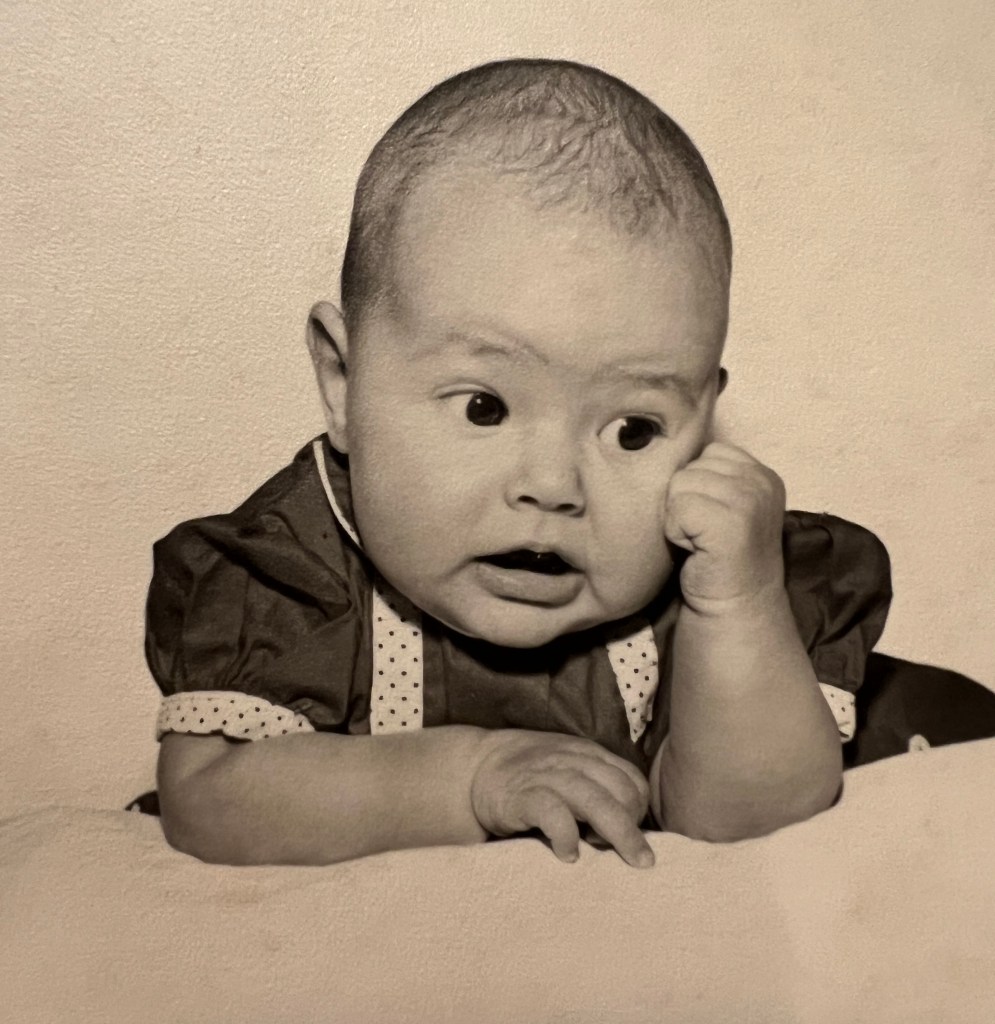
Me contemplating life at age 3 months

I have started humming this Beetles song lately: “Will you still need me, will you still feed me, when I’m 64.” I remember sitting in church when I was in Junior High school figuring out how old I would be in the year 2000—because that seemed so far in the future—like the Jetsons! I would be 40! Nearly ready for the nursing home, I thought at the time.

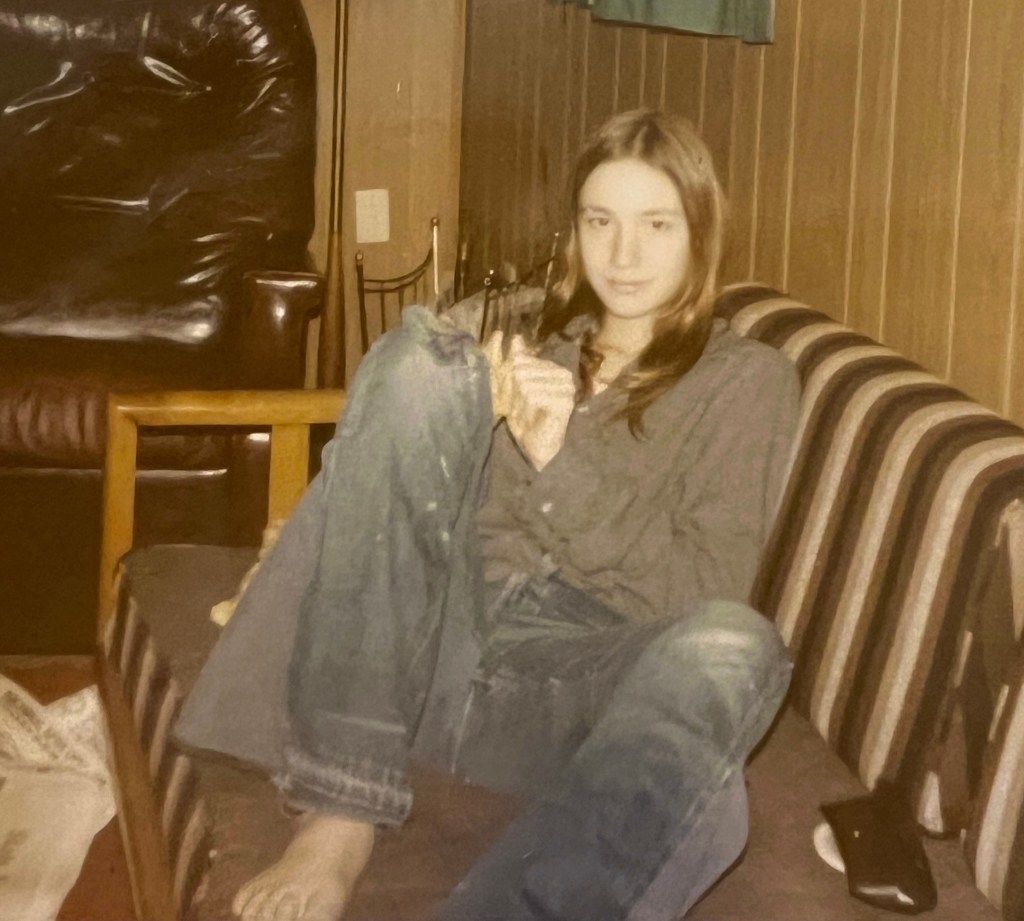
My Jr. High days

I recently went to the funeral of our pastor from my teenage years. What a legacy he had! Brother Delbert Wells (and his wife Beverly) were such a gift to me and so many more that God put in their path. He was like the pastor in the Jesus Revolution movie. In my hometown of Springfield, IL he opened his little church of Bethel to the hippies of the day. I was a Jr. hippie 🙂 ; old enough to wear bell bottoms and say, “Make love not war”, and have “Flower Power” written on my school notebooks and buy my blacklight posters from our local headshop called “Penny Lane”. Others in our church, and at our downtown Christian coffeehouse named LSD (for Lighter Side of Darkness), were “major” hippies just saved from the world of drugs and deep darkness. Brother and Sister Wells gave us respect, grace, a place in God’s Church and nurtured our individual callings. Their surrendered lives led us closer to God’s loving and perfect plan for our lives.

My early teen years

On the way home from Brother Wells’ funeral, I listened to The Great Divorce by C.S. Lewis. The following is my journal writing as I contemplated legacy and end of life, time passages, the final judgement and heaven:

“On the way down today, I listened to The Great Divorce. The last time I read it, I could barely understand the symbolism. Today it was rich. I thought of how clever of CS to illustrate all of us and thought that an evaluation of certain questions as the book is being read would be helpful: “Who are you in the story?” and “Which characters are your significant others in the story?” and “How can this work inform you on how to live and not live?”

I recall:

The inexplicable addiction to the Red Lizard of Lust which turned to a White Stallion of Desire after a difficult death to lust, bringing a rose brightness up the Mountain of Light.

The woman full of other-love that was really self-love in disguise, supposed love for son trumping love for God.  (Is this me?)

The theologian not wanting to let go of the questioning, the philosophizing, the open-endedness even after arrival in the surety of heaven. (Is this me?)

The teacher needing to teach for identity.

The painter wanting to paint heaven, but not to capture heaven’s radiance, but for his own reputation. (Is this me as poet/journaler/blogger/writer? Will I lay down my pen in heaven?)

The tragedian/disappearing dwarf chained and “their” wife—all glorious and exalted coming to them humbly beginning with apology but with the challenge to give up a quest for pity which only squelches joy.

The wife who always wanted her husband just to dominate/control/chide him.

George McDonald as CS’ guide—mentor—like Virgil & Beatrice for Dante.

The solidity of heavenly things and transparency of our un-surrendered selves.

Help me not to love learning most, but to love learning about YOU! Help me to lay down my search once you are found. Help me to lay down my “Religion” once I am in Your arms—Your sight—Your presence fully and eternally.

Help me now, Lord, to live a life so pleasing that I will have let go of all of “me” that is not under your Lordship.  Help me to examen—examine—and give me courage to let go—to hold on only to You and Your ways and Your will and desire for You!!  I know that is where peace is and truth and life and Light.  That is my only place of True Safety—True Love.”

And so, now that I’m turning 64, I continue praying this journal prayer. I pray that I will live well. I pray that I will serve well. I pray that I will age well. I pray that I will end well!

…Pray this along with me.