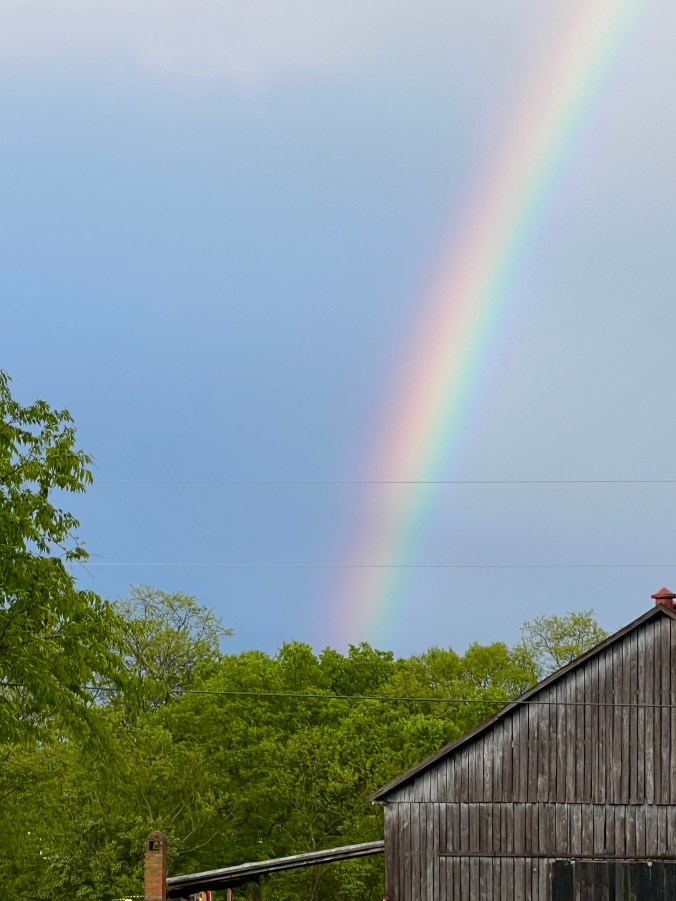
Wendell Berry died this week. The internet is filled now with photos and stories of the fortunate few who made it to his front porch for a talk with him. I am told not to envy but it is hard.
January 28, 2015, a friend and I went to hear Wendell Berry lecture at the Carnegie Center in Lexington, KY. Like an introverted paparazzo I snuck a few photos.
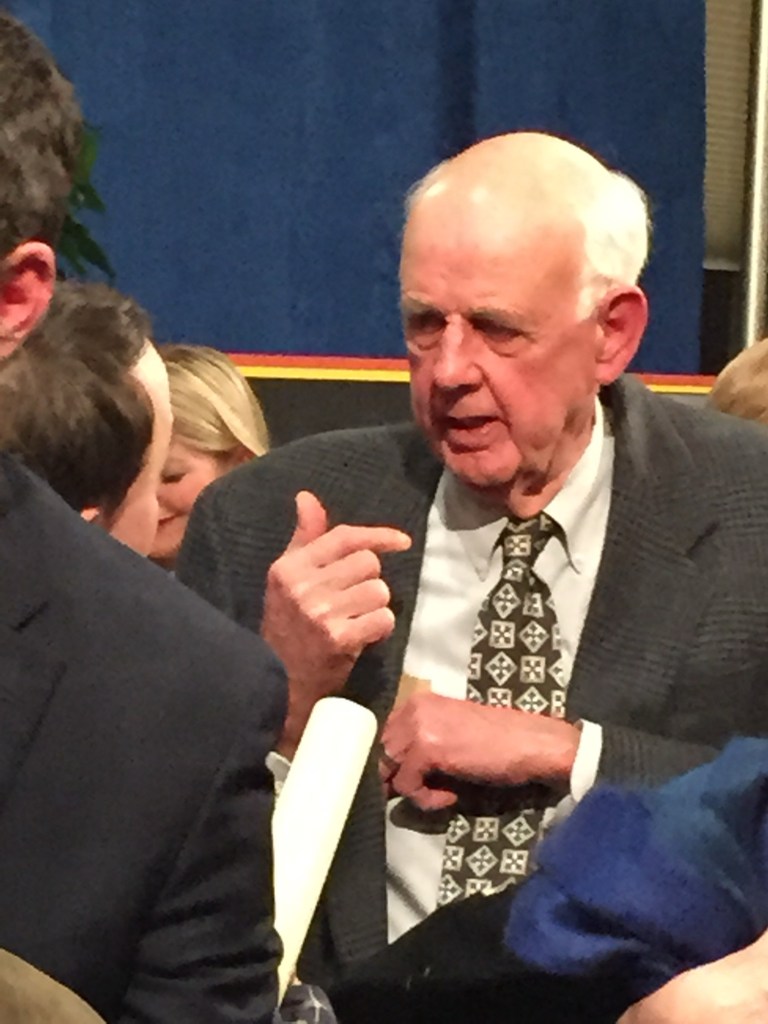
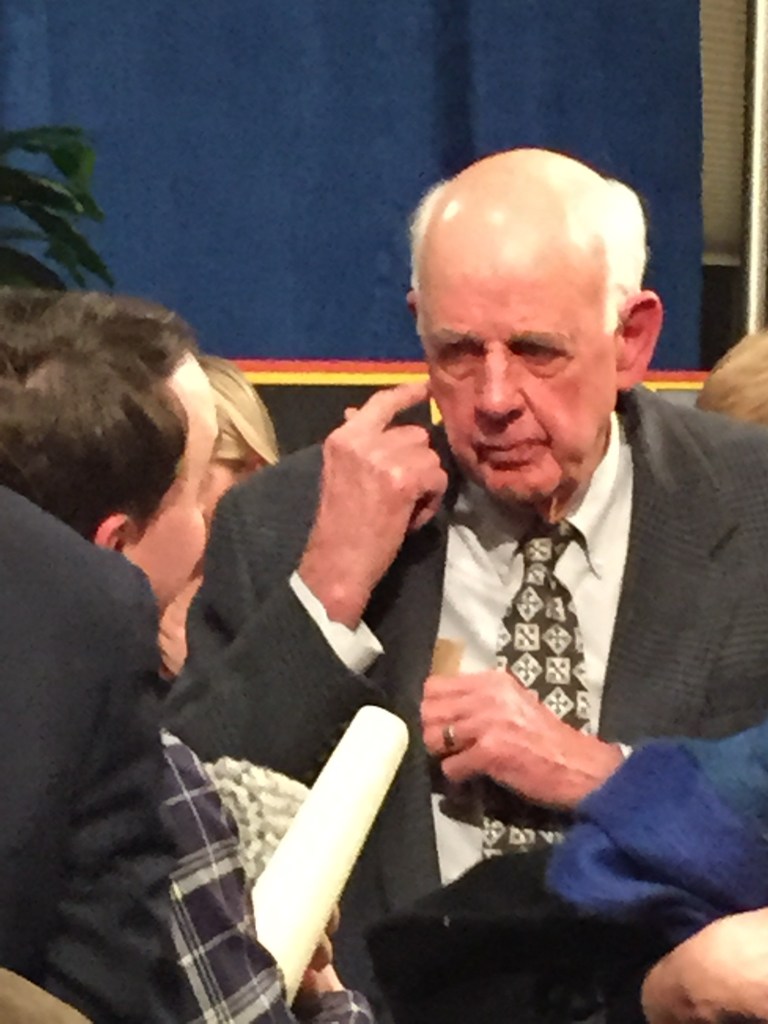
Then it was our turn to stand in line for him to sign our books. I had two. Standing in line, as a 50 something year old woman at the time, I started to feel like how I did as a junior high girl at a rock concert encountering one of the band members. I was sweaty, nervous, unsure of what to say, wanting to be seen, known, and acknowledged by this person I admired so much. My friend, who was a bit bolder than I, went through the line first. She pointed to me and said, “She lives downstream from you on the Kentucky River.” I’m sure my face reddened. He glanced up and replied, “Well, you always want to be friends with a neighbor living downstream from you.” … or something like that. My rememberer had shorted out by that point. Only later did I come across this Wendell Berry quote, “Do unto those downstream as you would have those upstream do unto you.”
When I got to Mr. Berry all I could eek out was, “Is it ok if I have two books for you to sign?” He replied, “Well if I said ‘no’ my publisher wouldn’t be very happy with me.”
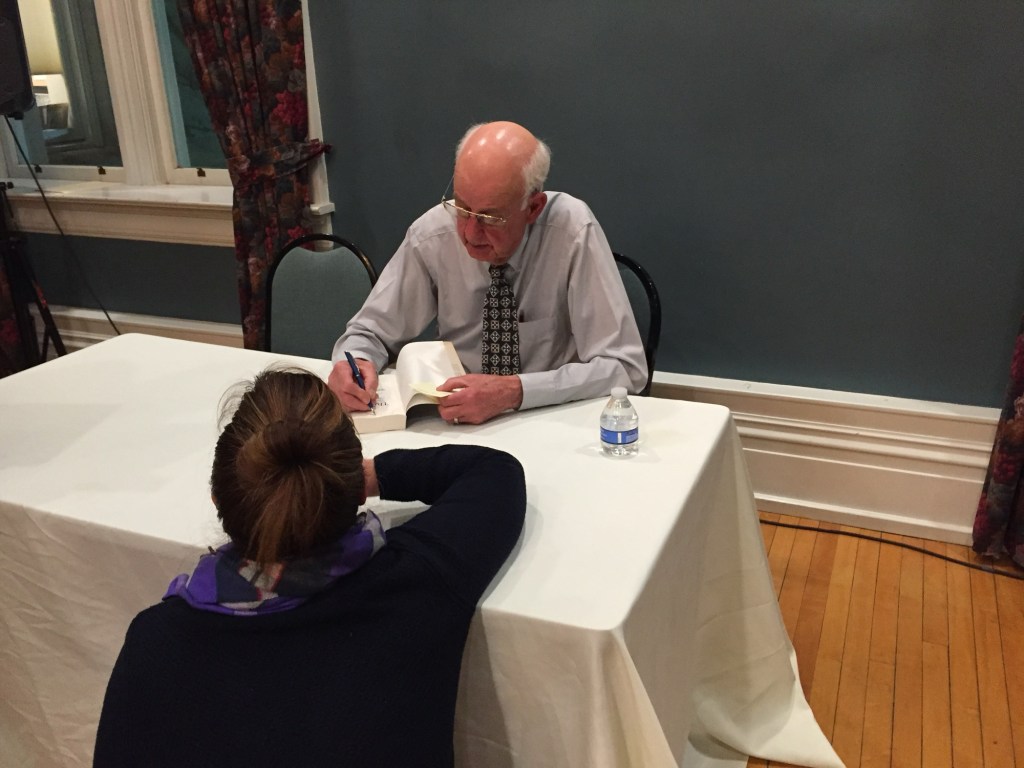
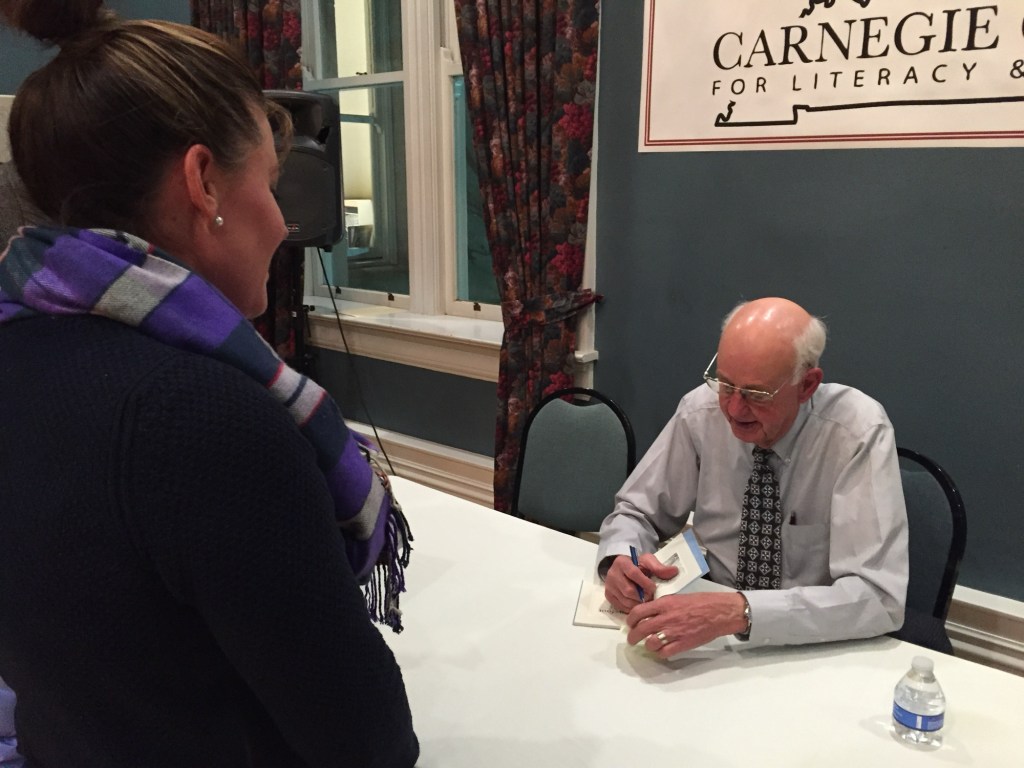
And, it was over.
And now I’ll give an even more embarrassing confession about myself; the me who is supposed to be mature and wise but apparently could still get carried away with teenagerly fandom. Two days after the Carnegie Center lecture my husband and I found ourselves passing near Port Royal, KY after going to a funeral. I asked if we could go investigate the little town since we both really liked reading about Wendell Berry’s Port William. We stopped and went inside the local hardware store and restaurant, and it felt like hallowed ground. I thought, “I’m sure Wendell Berry has walked this very aisle.” I suddenly wanted to be part of the Port Royal “membership” by buying something in the spirit of “neighborliness”, but the only thing slightly enticing me was a package of mouse traps, and I fought off the temptation. We continued our trek through the town passing by the local church and I pictured Tanya inside, maybe playing the piano while Wendell was out in the woods writing his “Sabbath” poetry.
Then, I went one step too far. I asked my husband if we could drive around to look for Wendell Berry’s home. I had seen some photos of his porch and front yard with solar panels in it. I knew he had a writing shack on the river near his home and low and behold we found it. I was giddy and embarrassed for being so “creepy” as to be doing this, yet my paparazzo nature came out again and I crouched down in the car snapping photos right and left hoping Wendell and Tanya were not peering out the window at this middle-aged groupie invading their private space.
Sometime later my husband and I traveled to The Berry Center in nearby New Castle, KY and Mr. Berry was there signing books. Again, I stood in line and was too nervous to know what to say. My husband, Hule, rarely suffers from having little to say, so he said all the words. In the conversation Wendell found out Hule was a pastor in the Wilmore, KY area and that initiated a few cordial sentences of exchange. But I was again mute, too starstruck to say or do much of anything more than just smile and take our freshly signed book from his hand.
What is it that makes us want a picture taken with someone or causes us to treasure an author’s signature in a book? It’s just ink on paper and yet it greatly increases a book’s value sentimentally and, for some books, even monetarily.
When I read Wendell Berry’s work it seemed like he was my friend, even my mentor. He reminded me so much of my dad. He was of the same era, worldview, and wise, contemplative, thoughtful temperament. Years ago when I gave Dad one of Wendell Berry’s books of agrarian essays, he thoroughly enjoyed it. He seemed awakened with interest by this author who respected the farm and rural life of my father’s upbringing and even his efforts to give proper respect to today’s rural life, agrarian people, and their communities and ways of being. It is what Dad had been trying to instill in us from the time we were little, and what he demonstrated to us with his life and reclamation of our family farm. I am grateful that in that one book exchange, before Dad faded and got to where he could read no more, Dad and Wendell Berry “met” on those pages.
I have returned to the Berry Center several times more recently hoping for a connection—a sighting, but it never happened. And now I have learned that it never will. I have missed him.
I once ordered a print of a photo by Tanya Berry that was displayed in one of the rooms at the center. It reminded me of my grandparents, their farm, and the simple life they lived. The photograph now hangs in my kitchen and greets me daily. Sometimes I drift into daydreams of Tanya and I discussing photography and recipes.
One of the first fiction books I read by Wendell Berry was Hannah Coulter. I was astounded by the way he captured the mysterious experience of a nursing mother:
I took her into bed with me and propped myself up with pillows against the headboard to let her nurse. As she nursed and the milk came, she began a little low contented sort of singing. I would feel milk and love flowing from me to her as once it had flowed to me. It emptied me. As the baby fed, I seemed slowly to grow empty of myself, as if in the presence of that long flow of love even grief could not stand.
Wendell Berry, Hannah Coulter
I believe it was the essence of that passage that inspired me to write this poem:
I Am Mother
I lie down and surrender to love and risk.
Protection withdrawn, my womb opens to receive another.
My fertile bed prepared by God opens its lips to the seed.
The race is on—unpredictable and exciting—one possibility meets thousands and chooses one.
A match is made
A fire strikes
Burning and burrowing beneath the soil of blood and mystery.
I wait. I look to stars. I con-sider. I lie still. Selah
We test “waste” to know your presence. We listen and peer in with sound waves.
I lie down once again and look to screen and risk seeing you and falling madly,
deeply,
forever in love.
I carry you around in my purse and pouch and put you on my refrigerator and marvel at the blurry, fuzzy jelly bean sized person in me,
Who is you.
I wait. I look to stars. I con-sider. I lie still. Selah
I begin to pant and feel squeezing—tightness
Yes—pain
Intense—severe
I risk death with joy and moaning, for you.
You have kicked in me, punched my ribs, rolled like a bowling ball inside me.
How I have longed to see you and touch you and now it is immanent and I am scared.
As you emerge I am born.
I am mother.
I hold you.
I wait. I look to stars. I con-sider. I lie still. Selah
I give my days and nights to you.
I give my body once again—my rest and food, vitamins and drink all churn inside me until milk comes flowing through my chest to nourish you…sustain you.
My hours are yours, my body is given—scarred, stretched, engorged.
This is my body, broken for you. Take and eat.
You snort and grunt, draw near to suckle, your hands knead like a cat on a blanket, like a baker with his dough.
I wait. I look to stars. I con-sider. We lie still. Selah
Since my middle school days there are very few people I have wanted to meet or get to know or know me, but Wendell Berry was one. There is an admiration there. Someone who has my respect. Someone I often quote, even in this very blog. Someone from whom I believe I could have learned good things. After I read Theo of Golden several years ago, I felt the same way about the author Allen Levi. I even thought—this guy reminds me of Wendell Berry! I have yet to go stalk Mr. Levi, but I did hear myself saying to a friend, “There are very few people I’d like to meet, but two of them are Wendell Berry and Allen Levi. I would love to sit at a dinner table with them and talk to them.” Later I imagined that scene and knew I would likely be so star-struck I couldn’t even manage asking a question, let alone allow myself to speak articulately enough so as to become known. I also understand that these gifted people only have so much capacity and it seems insensitive to ask to take up a portion of their limited, valuable time.
And yet, today, I grieve. I have missed him. I will miss him. I pray for and grieve for his family and friends. I grieve the loss of my hope of becoming one of those friends and the loss of this man with so much wisdom who has now laid down his sharpened No. 2 pencil and yellow notepad.